Michael Anderson (@michaelanderson)
Global Term Premiums Turn Positive as Bond Markets Reject Decades of Low-Cost Government Borrowing
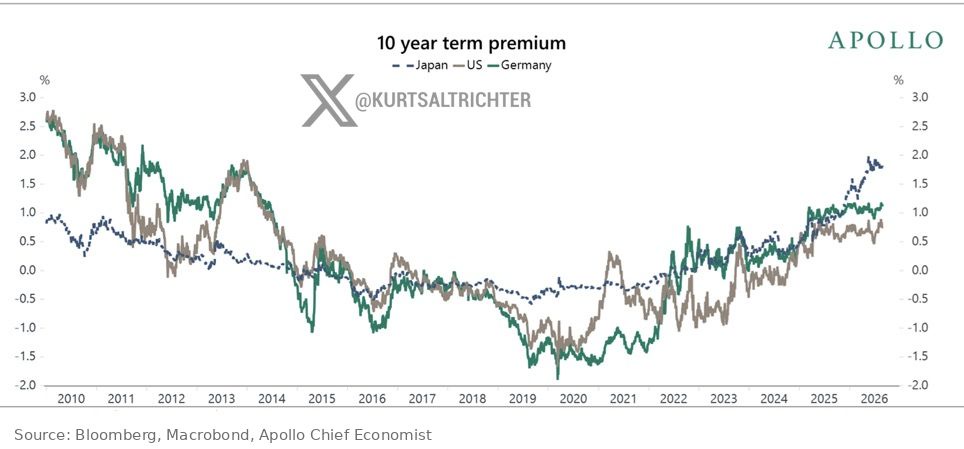
The 10-year term premium—representing the additional yield investors demand to hold long-term government debt—has transitioned from deeply negative to firmly positive across major economies, including the United States, Germany, and Japan, with Japan currently leading the range.
This shift signifies that bond markets are no longer willing to subsidize state borrowing, forcing long-term yields upward independently of central bank policy rate cuts. Driven by persistent fiscal deficits, higher term premiums directly increase borrowing costs across the economy, impacting mortgage rates, long-duration technology valuations, and sovereign debt servicing expenses.
With structural supply pressures returning to sovereign debt markets, the era of repressed long-term yields has concluded, leaving central banks with limited tools to suppress the longer end of the curve.