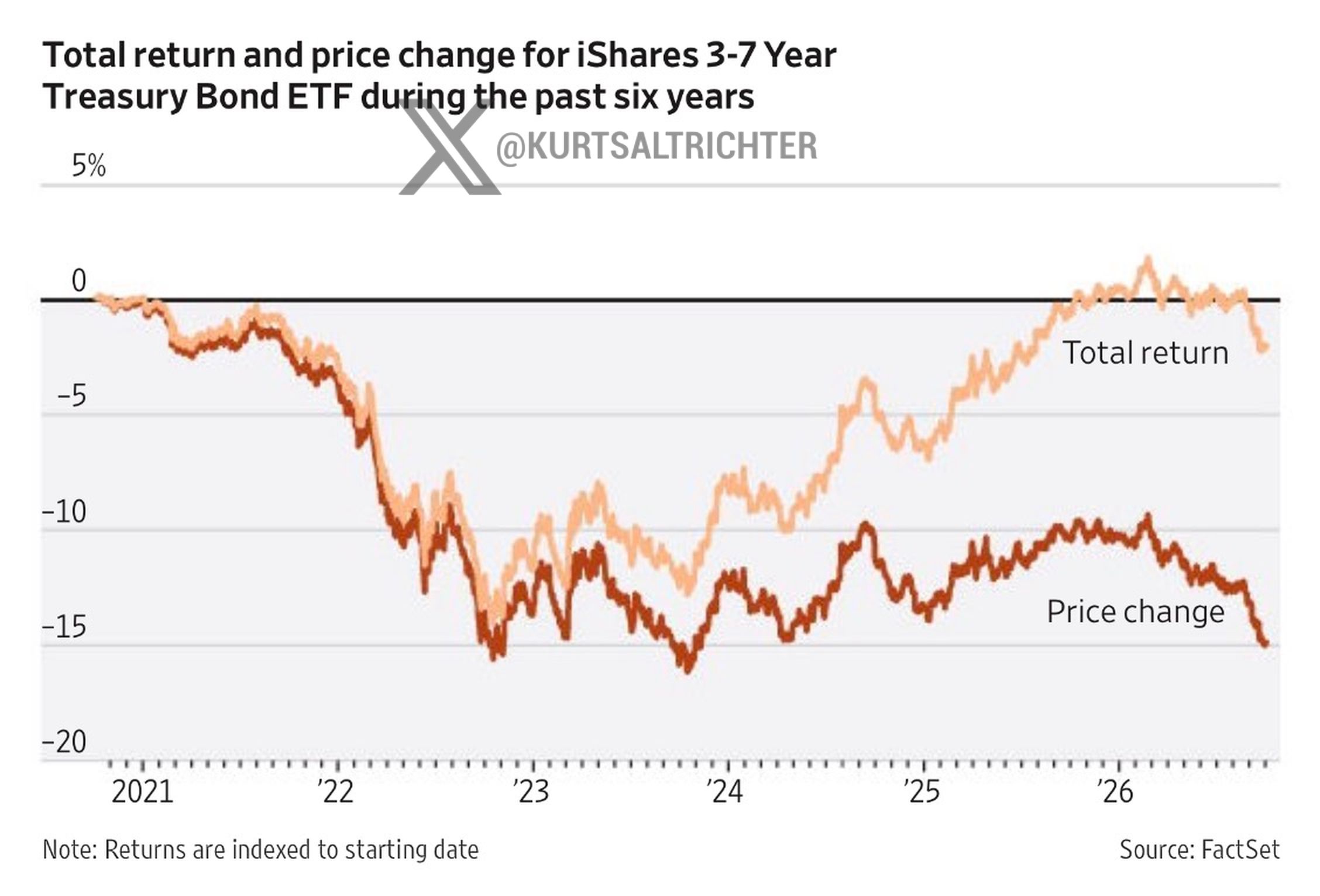
Fixed Income Total Return Analysis: Coupon Cash Flows Offset 15% Treasury Fund Price Drawdown
Over the past six years, benchmark U.S. Treasury bond funds have experienced capital depreciation of roughly 15% as benchmark yields climbed toward multi-decade highs. Despite significant principal mark-to-market drawdowns, aggregate total return across the period hovered near flat, underscoring the structural mechanics of fixed-income returns in an elevated-rate regime.
The divergence between price return and total return highlights key strategic distinctions for fixed-income investors:
- Income Cushioning (Reinvestment Effect): While rising discount rates compress bond principal prices, higher running yields and regular coupon distributions generate cash flows that mathematically offset capital losses over time.
- Cash Flow vs. Duration Speculation: Investors utilizing individual bonds or fixed-income sleeves for contractual cash flows and held-to-maturity yields experience price volatility primarily as accounting noise. In contrast, tactical allocations reliant on capital appreciation from rapid rate cuts face extended duration drag.
- Structural Paradigm: In a sustained high-yield macro environment (with 10-year yields holding above 5%), portfolio return profiles shift away from zero-rate-era capital gains toward steady, compounding coupon reinvestment.