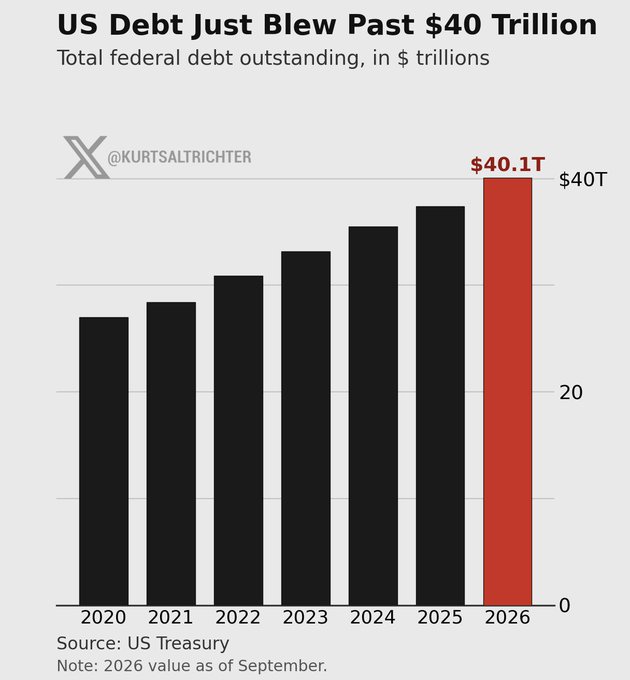
U.S. Federal Debt Crosses $40 Trillion as Treasury Supply Keeps Rising
U.S. federal debt has now crossed the $40 trillion mark.
The source puts the increase over the past year at roughly $2.67 trillion, equivalent to more than $7 billion of additional debt per day.
The important market issue is not whether the government eventually “pays off” the entire stock of debt. In practice, maturing Treasuries are continuously refinanced while new borrowing is issued to fund ongoing deficits.
That means a larger debt burden can translate into greater Treasury supply and higher interest expenses, particularly when refinancing happens at elevated yields.
The claim that this debt will automatically be “monetized” is less certain. Federal Reserve asset purchases and money creation depend on monetary policy decisions rather than occurring automatically whenever Treasury borrowing increases.
Still, persistent deficits can create a difficult backdrop if investors demand higher yields to absorb growing issuance.
The bearish-dollar thesis is that sustained fiscal deficits, combined with inflation or future monetary easing, could gradually erode purchasing power.
That is why some investors favor scarce or supply-constrained assets such as gold, commodities, real estate and $BTC as potential long-term hedges, although their performance is not guaranteed simply because government debt is rising.