Oil Market Is Becoming Numb to U.S.-Iran Escalation
Oil’s reaction to the U.S.-Iran war is getting smaller.
Iran has now warned that it is shifting to a “fully offensive” military posture after efforts to secure a permanent agreement with Washington stalled.
The temporary ceasefire arrangement has expired.
Shipping through the Strait of Hormuz remains severely restricted.
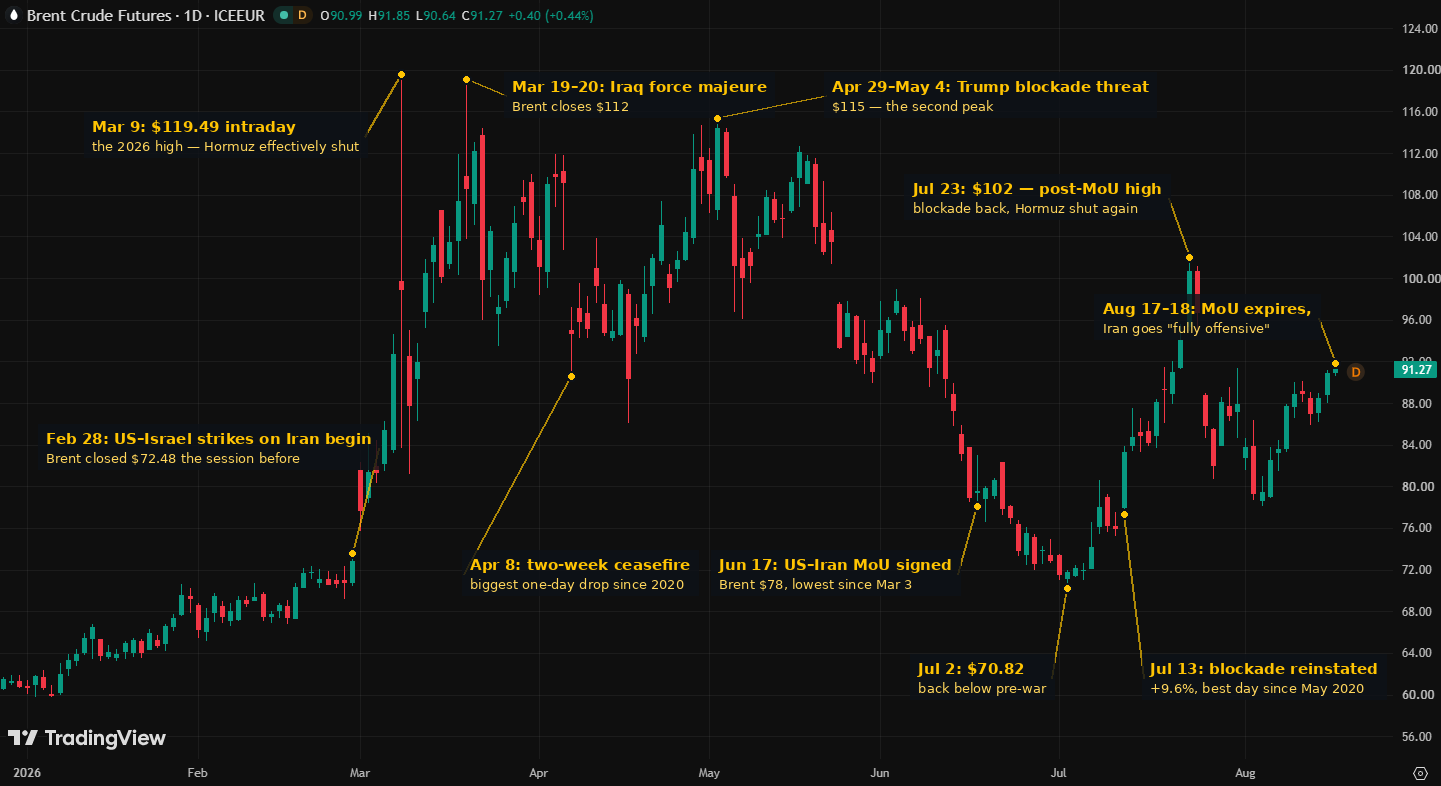
And yet Brent crude is trading only around $91 per barrel.
Compare that with the early stages of the conflict.
When the war began at the end of February, oil immediately surged.
As Hormuz disruptions intensified in March, Brent eventually reached a wartime peak around $120-$126 per barrel.
Later escalations repeatedly produced violent double-digit moves in crude.
Now the market is reacting very differently.
Even after renewed tanker attacks, an indefinite U.S. blockade threat, collapsing peace negotiations and Iran threatening a fully offensive posture, Brent remains more than $30 below its wartime peak.
That suggests the market may be adapting to the conflict.
Traders have had months to price in disrupted Hormuz flows, alternative export routes have expanded, strategic reserves have been released and weaker global demand is limiting how much geopolitical risk can push crude higher.
The war is still escalating.
But the oil market is no longer reacting like every escalation is a new shock.
That may be one of the biggest changes in the Iran trade.