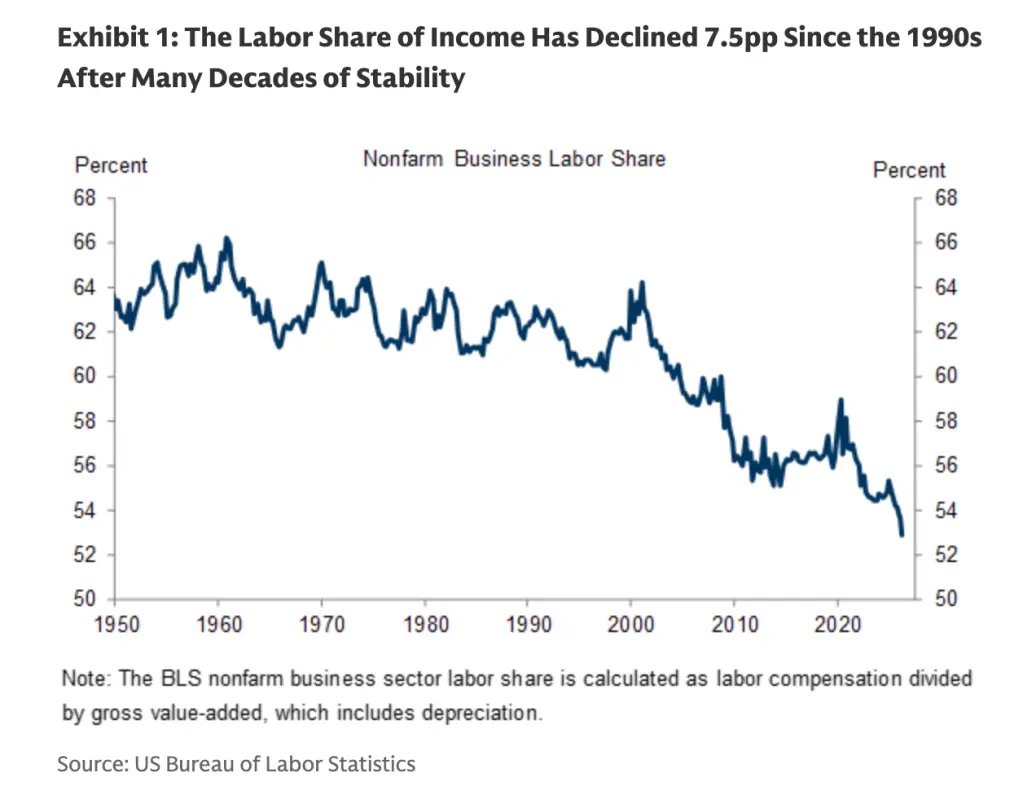
Workers now capture the smallest share of business income on record
The share of national economic output flowing to American workers via wages and salaries has fallen to its lowest level on record, according to data from the Bureau of Labor Statistics (BLS) and the Federal Reserve. In the nonfarm business sector, the labor share of income declined to 52.8% in Q2 2026—the lowest reading since the federal government began tracking the metric in 1947.
By comparison, the labor share regularly hovered above 64% to 65% in the post-WWII decades and stood at 57.7% prior to the pandemic in early 2020. Corporate-sector compensation data compiled by economic research groups shows that workers now capture roughly 71.3% of corporate income, down from 77.8% at the start of 2020.
The structural decline highlights a long-term divergence where productivity gains and operating revenues are increasingly allocated toward corporate profits, stock buybacks, executive equity compensation, and dividend distributions rather than baseline payroll expansion. Economists cite several structural catalysts behind the drop, including declining collective bargaining density, increasing corporate market concentration, supply-chain automation, and technological displacement.
From a market perspective:
- Corporate Margins (Bullish): In the near term, a compressed labor share preserves operating leverage and protects corporate net margins from escalating unit labor cost (ULC) pressures.
- Consumer Demand (Bearish Risk): Over a multi-quarter horizon, sustained real wage compression threatens the durability of consumer spending, which accounts for ~70% of U.S. GDP, reinforcing late-cycle K-shaped macroeconomic dynamics.