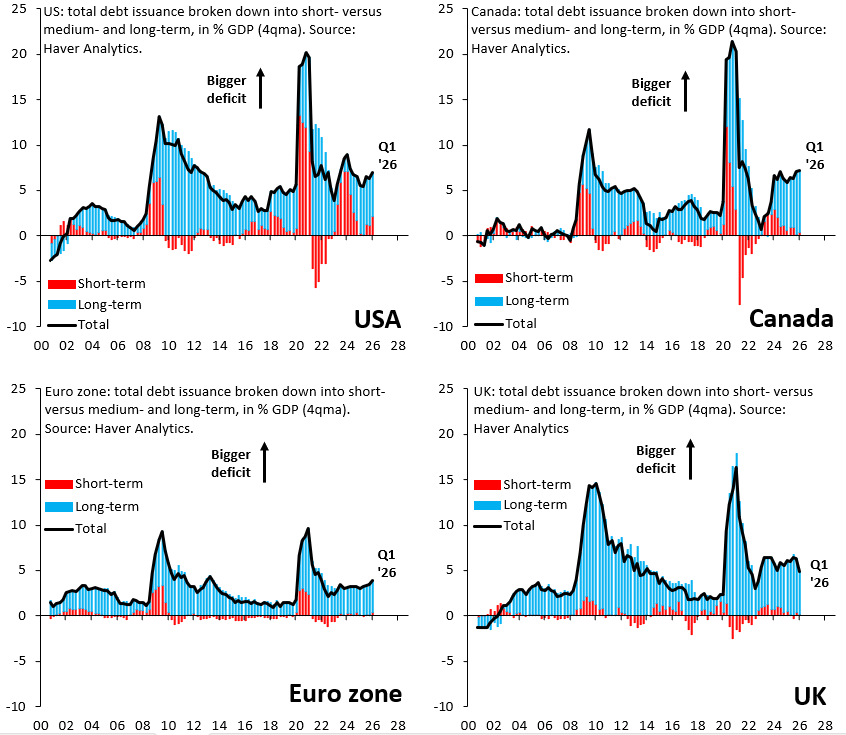
The Global Debt Problem Is Moving to the Short End
Government borrowing across the G10 remains far above pre-COVID levels.
Large fiscal deficits are forcing governments to issue enormous amounts of new debt, while investors are demanding increasingly high compensation to hold longer-dated bonds.
That is pushing more borrowing toward the short end of the yield curve.
The shift can reduce immediate interest costs and make new debt easier for markets to absorb.
But it creates another problem:
Short-term debt has to be refinanced much more frequently.
If interest rates remain elevated, governments roll that debt over at higher costs much faster than they would with longer maturities.
The result is a dangerous feedback loop.
Large deficits create more issuance.
More issuance pressures bond markets.
Higher yields increase government interest expenses.
And higher interest expenses make deficits even larger.
This is not just a U.S. problem.
Similar pressures are appearing across major developed economies as governments carry much larger debt loads than they did before COVID.
The global debt crisis does not need to begin with a default.
It can begin with governments increasingly struggling to find buyers for long-duration debt at prices they can afford.