The Illusion of Diversification: How AI Capital Expenditure Captured Global Asset Classes
The thesis that modern asset allocation offers genuine structural diversification is breaking down as hyperscale artificial intelligence capital expenditure permeates equities, fixed income, emerging markets, and private capital simultaneously.
Key concentration risks and cross-asset correlations include:
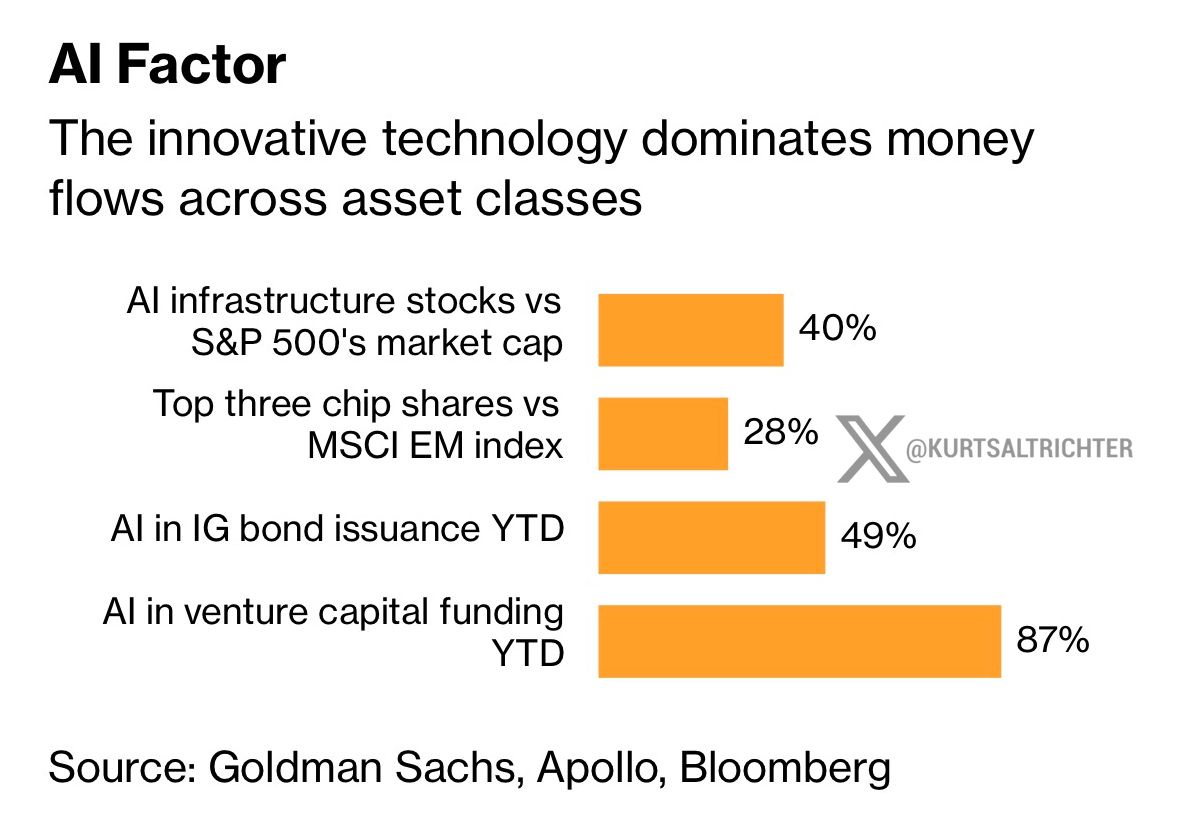
• Public Equity Dominance: Mega-cap tech and semiconductor infrastructure now account for roughly 40% of the S&P 500's total market capitalization, leaving cap-weighted index investors exposed to a single hardware and software spending cycle.
• Emerging Market Concentration: Rather than offering uncorrelated growth, emerging market benchmarks are heavily skewed toward the semiconductor supply chain, with just three foundry and memory giants (TSMC, Samsung Electronics, and SK Hynix) comprising over a quarter of the MSCI Emerging Markets Index.
• Debt & Private Capital Monoculture: In the search for power and compute infrastructure, tech hyperscalers and utility partners account for roughly half of year-to-date investment-grade corporate bond issuance, while 87% of venture capital funding remains concentrated in foundation models, AI agents, and custom silicon.
• Cross-Asset Contagion: The convergence means traditional 60/40, multi-asset, and private-equity diversifiers essentially repackage the same underlying thesis—sustained enterprise AI monetization—leaving balance sheets vulnerable if capex ROIs compress.