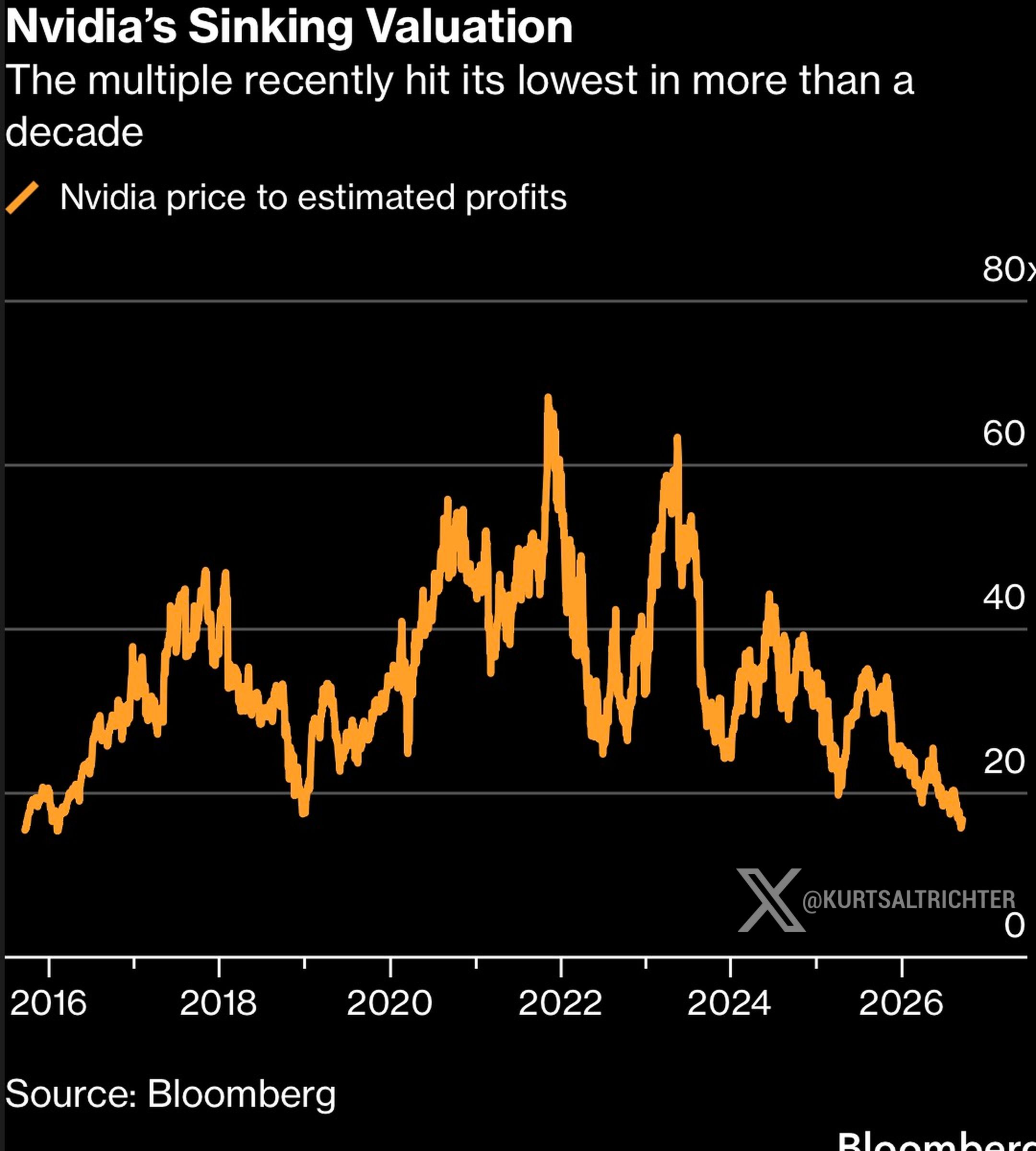
Nvidia Valuation Multiple Compresses to Multi-Year Lows as Massive EPS Expansion Outpaces Stock Gains
Debate over Nvidia ($NVDA) valuation has inverted as aggressive consensus earnings growth sharply compresses the chipmaker’s valuation multiples, bringing its forward price-to-earnings (P/E) ratio toward historical lows. Down significantly from peak valuation multiples of ~65x in 2022, Nvidia now trades at a steep discount to peer semiconductor rivals like AMD and Marvell, and roughly in line with or below the broader S&P 500 baseline.
This multi-year multiple contraction reflects distinct macro and fundamental drivers:
- Structural Earnings Acceleration ("Growing Into the Valuation"): The primary driver of multiple contraction is the denominator: net income and free cash flow expanded at triple-digit year-over-year rates, outpacing nominal share price appreciation. When quarterly profits expand faster than market capitalization, the valuation multiple naturally collapses without requiring price destruction.
- Hyperscaler Capex & Longevity Scrutiny: The compressed multiple signals growing institutional skepticism over the sustainability of Big Tech AI capital expenditures. The market is increasingly pricing in cyclical risk—questioning whether cloud providers face an air pocket in hardware digestion, rising chip depreciation burdens, or diminishing returns on generative compute clusters.
- Re-rating from Speculative Multiple to Cash-Flow Reality: Historically, extreme P/E multiples signal speculative mania, whereas single-to-low-double-digit multiples on high-margin monopoly hardware indicate widespread peak-of-cycle fears.
From a market structure perspective, Nvidia's compressed multiple indicates that rather than trading on speculative euphoria, the stock is currently pricing in substantial cycle-end pessimism, creating an asymmetric setup where any sustained extension of the AI capex buildout forces an aggressive upward multiple re-rating.