education
Best Options Flow Tools for Smarter Trade Research
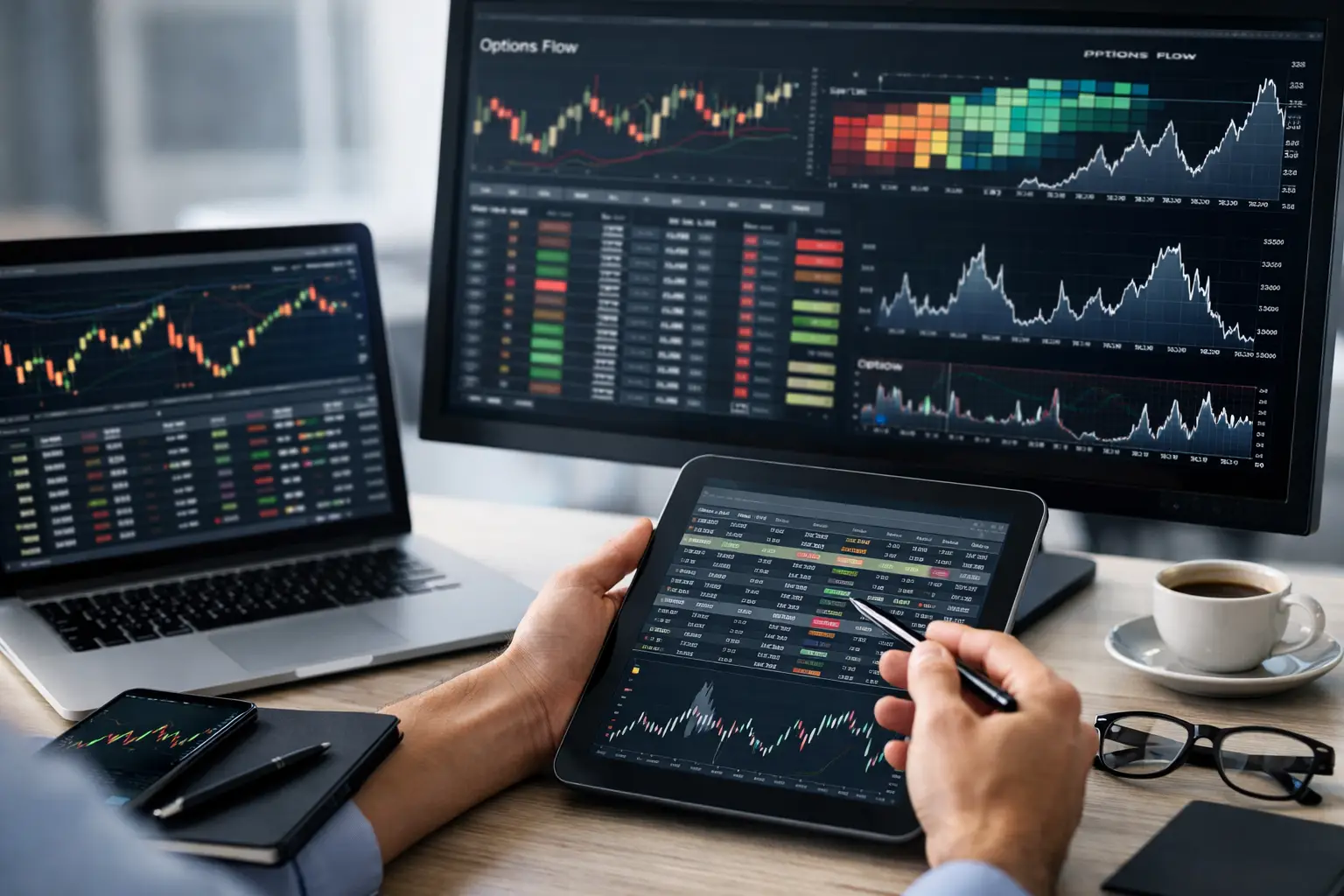
Compare the best options flow tools for verified signals, contract context, and disciplined trade research across fast-moving US equity and ETF markets.
Options flow can look decisive right up until it is not. A $2 million premium print in a popular stock may reflect a directional conviction trade, but it can also be part of a hedge, a roll, a spread, or an institutional position with risk defined somewhere else. The best options flow tools do not merely surface large orders. They give traders enough context to decide whether a print deserves attention, further research, or no action at all.
For active traders, flow is most valuable as a market-intelligence input . It can reveal where sophisticated participants are expressing urgency, targeting a particular expiration, or positioning around a known catalyst. It cannot replace a thesis, a technical level, position sizing, or risk management. The difference matters, especially in a market where screenshots of unusual contracts can travel faster than the trade’s actual meaning.
What separates the best options flow tools
A useful flow platform starts with speed, but speed alone is a weak standard. Raw options data generates an overwhelming amount of noise. A platform should help users filter that noise by showing whether a contract traded at the bid, ask, or midpoint; whether it was a call or put; the premium involved; volume relative to open interest; expiration; strike; and underlying price behavior.
The highest-value tools also make it easier to identify structure. A single sweep can be interesting. Repeated activity at the same strike and expiration, across multiple exchanges, is more informative. A call purchase may appear bullish, yet the surrounding chain can reveal a call spread or covered-call transaction that changes the interpretation completely.
Data transparency is another dividing line. Traders should be able to see the contract details behind an alert rather than rely on a simplified label such as “bullish” or “bearish.” Sentiment tags are useful for triage, not proof. The more a tool shows its work, the easier it is to build an independent view of the trade.
The leading options flow platforms by use case
There is no universal winner because options flow tools serve different workflows. Some are built for fast, visual scanning. Others prioritize deep filtering, unusual activity history, or market-maker positioning. The right choice depends on whether you are trading intraday momentum, multi-day swings, earnings events, or broad index exposure.
Unusual Whales for broad retail-accessible flow research
Unusual Whales is a widely used platform for traders who want extensive unusual-options activity, historical context, alerting, and a highly active market community. Its appeal is breadth. Users can move from a notable contract to options-chain data, congressional trade disclosures, dark-pool information, news-oriented context, and broader market discussion without treating the alert feed as the entire analysis.
It is particularly useful for traders who want to learn how flow behaves across different names and sectors. The trade-off is information density. Newer users can mistake a high volume of alerts for a high volume of opportunity. A disciplined filter set and a defined watchlist are essential.
Cheddar Flow for clean real-time visualization
Cheddar Flow is often favored by traders who want a straightforward view of unusual activity and market flow without an overly complex interface. Its visual presentation can make it easier to scan premium, expiration, strike, and directional classifications during a fast session.
That simplicity can be a real advantage for intraday traders who need a focused screen. It may be less suited to users seeking a broad research ecosystem or highly specialized derivatives analytics. As with any alert-driven product, the value comes from pairing the flow with price action, liquidity, and a clear plan for entry and exit.
FlowAlgo for active alert-based trading
FlowAlgo focuses on real-time unusual-options alerts, sweeps, blocks, and dark-pool activity. It is designed for participants who want notifications when significant transactions hit the tape and who can quickly investigate whether the activity aligns with current market structure.
This approach works best when speed is part of your edge. If you cannot monitor alerts consistently, a fast feed can become a source of late entries and reactive decisions. FlowAlgo can be effective for active traders, but it rewards process: filter aggressively, verify the underlying trend, and avoid treating every aggressive call sweep as a buy signal.
BlackBoxStocks for multi-market active trading
BlackBoxStocks combines options flow with scanners, alerts, charting features, and community-oriented market tools. It can appeal to traders who want to evaluate options activity alongside equity momentum rather than in a separate research environment.
The multi-tool setup is useful when a trader’s process includes both stock and options execution. The trade-off is that broader functionality can require more time to configure and learn. A platform with many scanners is only as effective as the criteria behind them.
SpotGamma for dealer positioning and index context
SpotGamma occupies a different category from a conventional flow scanner. Its research centers on options positioning, gamma exposure, and how dealer hedging may influence market behavior. That makes it especially relevant for traders focused on SPX, SPY, QQQ, major expirations, and index-driven volatility.
For a trader trying to understand why a market may become pinned near a strike or accelerate after a key level breaks, positioning analysis can add context that individual flow alerts cannot. It is less about copying a specific contract and more about understanding the environment in which that contract trades.
How to evaluate flow before acting
The strongest workflow begins before the alert arrives. Build a focused universe of liquid stocks, ETFs, and indexes you understand. Then use flow to prioritize names already approaching a technical level, earnings event, macro catalyst, or sector inflection point.
When a trade appears, start with the contract. Is it short-dated or several months out? Does volume materially exceed open interest? Did the transaction execute near the ask, suggesting urgency, or near the midpoint where intent is less certain? Is the premium large relative to the stock’s typical options activity? These questions narrow the field, but they do not establish direction on their own.
Next, inspect the chain and the tape around the time of execution. A trader buying calls may also be selling higher-strike calls. A put purchase can be a downside bet, portfolio insurance , or a component of a larger volatility position. Repeated orders can matter more than a single headline-sized transaction, particularly when they continue as the underlying holds a key level.
Finally, compare the flow with the underlying chart and catalyst calendar. If call activity appears while the stock is reclaiming a major moving average on expanding volume, the setup may deserve a closer look. If the same flow appears after an extended vertical move into earnings, the risk profile can be entirely different. Context determines whether flow is confirmation or temptation.
Build a connected research process
Fragmented workflows create avoidable blind spots. A flow scanner in one tab, a charting platform in another, portfolio risk somewhere else, and market discussion on an unverified social feed forces traders to reconstruct the market manually. That is slow, and it makes it easier for low-quality information to shape decisions.
A connected financial intelligence environment should let users move from market activity to analysis, discussion, and risk awareness with a clear audit trail. On Tyrian Trade, that broader objective aligns with verified participation, AI-assisted market intelligence , portfolio analytics, and community-led discovery. The goal is not to make every trader follow the same signal. It is to make the reasoning behind a market view more transparent.
A better standard for options flow
The best tool is the one that fits your decision horizon and makes its data understandable. For rapid alerting, a streamlined flow feed may be enough. For index traders, dealer positioning may carry more weight. For developing traders, the most valuable platform may be the one that helps explain why a trade is notable rather than simply announcing that it happened.
Treat options flow as evidence, not instruction. When a platform gives you contract-level transparency, relevant filters, and a way to connect activity to the broader market, it can sharpen research without replacing judgment. That is the standard worth carrying into every alert.