market
Dollar Jumps to Highest Since November on Fed Rate Hike Bets
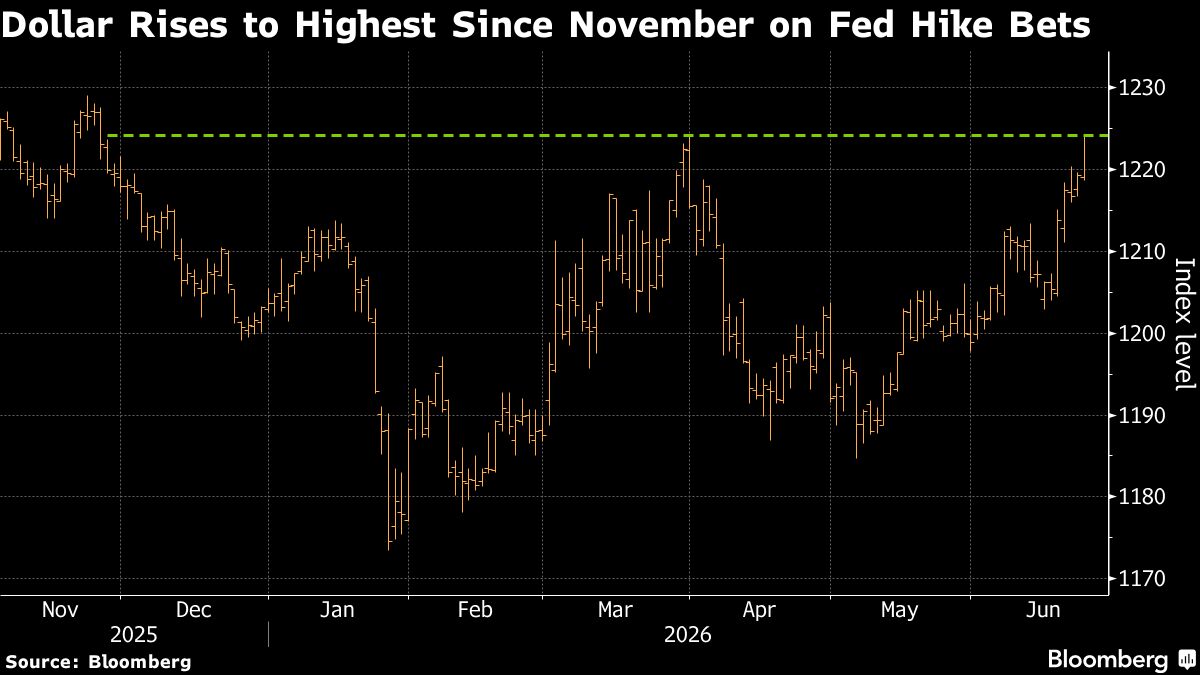
The dollar reached its highest level since November on Tuesday as traders cement expectations for Federal Reserve interest rate hikes in 2026.
The dollar touched the highest level since November on Tuesday as traders cement views on the Federal Reserve hiking interest rates this year, according to Bloomberg Markets. The currency move reflects shifting market expectations around the central bank's monetary policy trajectory, with investors repricing the likelihood of tighter policy ahead. The strengthening dollar carries implications for global trade flows, emerging market currencies, and cross-border investment returns.
Key takeaways
The dollar reached its highest level since November on Tuesday, June 23, 2026
Traders are cementing expectations that the Federal Reserve will hike interest rates in 2026
Currency markets are repricing monetary policy expectations, which affects global capital flows and trade competitiveness
Dollar strength typically reflects relative interest rate differentials and safe-haven demand during policy uncertainty
Table of Contents
What happened
Why it matters
What to watch next
What happened
The dollar touched the highest level since November on Tuesday, June 23, 2026, according to Bloomberg Markets. This currency move occurred as traders cement their views on the Federal Reserve hiking interest rates this year. The strengthening reflects a shift in market positioning around U.S. monetary policy, with investors adjusting their portfolios based on expectations for tighter financial conditions ahead.
The timing of this dollar strength coincides with evolving Federal Reserve policy expectations. Currency markets are forward-looking instruments that price in anticipated central bank actions well before official announcements. When traders collectively shift their rate hike expectations, the dollar typically responds by strengthening against other major currencies as capital flows adjust to reflect higher anticipated returns on dollar-denominated assets.
Why it matters
Dollar movements carry significant implications across global financial markets. When the dollar strengthens, it affects international trade competitiveness, emerging market debt servicing costs, commodity prices typically denominated in dollars, and cross-border investment returns. A stronger dollar makes U.S. exports more expensive for foreign buyers while making imports cheaper for American consumers. For multinational corporations, currency fluctuations can materially impact reported earnings when foreign revenues are translated back into dollars.
Federal Reserve interest rate policy remains the primary driver of dollar valuation over medium-term horizons. When the Fed raises rates or markets anticipate rate hikes, dollar-denominated assets offer higher yields relative to other currencies, attracting capital inflows. This dynamic creates a feedback loop where rate hike expectations drive dollar strength, which in turn can influence inflation dynamics by making imports cheaper. The interplay between monetary policy expectations and currency markets represents a critical transmission mechanism through which central bank decisions affect the broader economy.
What to watch next
Market participants should monitor upcoming Federal Reserve communications for clarity on the timing and magnitude of potential rate hikes. Federal Open Market Committee meeting minutes, speeches by Fed officials, and economic data releases such as inflation reports and employment figures will provide insight into whether current market expectations align with the central bank's policy intentions. Any divergence between market pricing and Fed guidance could trigger volatility in currency markets as traders adjust their positions.
The dollar's trajectory will also depend on relative monetary policy stances across major economies. If other central banks signal tightening while the Fed pauses, or if economic data weakens and calls Fed rate hike expectations into question, the dollar could reverse recent gains. Currency markets remain sensitive to geopolitical developments, risk sentiment shifts, and changes in global capital flows. Traders should watch dollar index levels, currency pair volatility measures, and interest rate futures markets for early signals of shifting expectations around Fed policy and dollar direction.
Read original source