market
MSCI Says Low Free-Float Among Many Hurdles for Vietnam Stocks
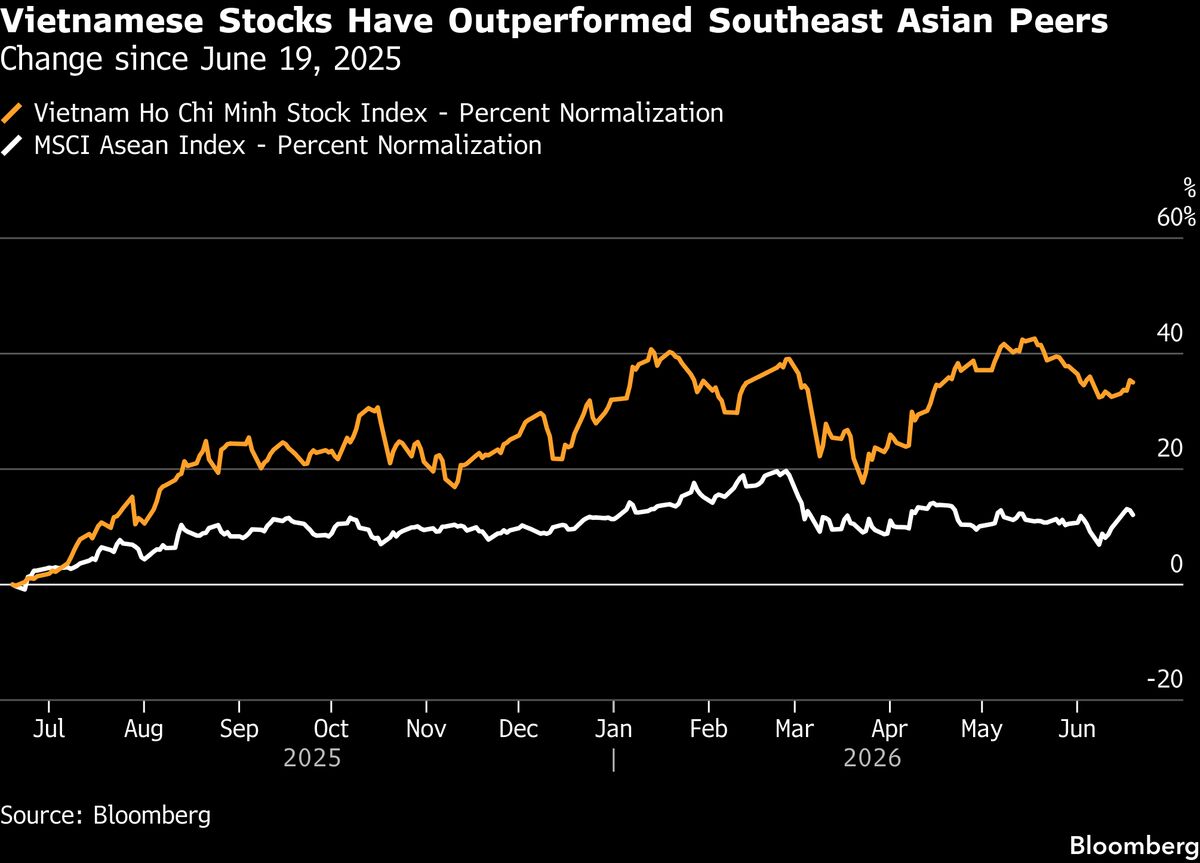
MSCI flags low free-float and foreign ownership caps as key hurdles blocking Vietnam's push for an emerging market status upgrade.
<p>Vietnam's ambition to secure a coveted emerging market classification from MSCI Inc. faces a complex set of structural obstacles, according to the global index provider. Low free-float levels at a number of Vietnamese-listed companies, combined with persistent restrictions on how much foreign investors can own in domestic firms, are among the most significant barriers standing between the country and a potential reclassification. For traders and portfolio managers with exposure to Southeast Asian equities, understanding the depth of these challenges is essential to calibrating expectations around the timeline and probability of an upgrade.</p><h2>Table of Contents</h2><ul><li><a href='#background'>Vietnam's Upgrade Ambitions: The Stakes</a></li><li><a href='#free-float'>Free-Float Constraints and Why They Matter</a></li><li><a href='#foreign-ownership'>Foreign Ownership Limits: A Structural Ceiling</a></li><li><a href='#msci-framework'>How MSCI Evaluates Market Accessibility</a></li><li><a href='#outlook'>Investor Outlook and Strategic Implications</a></li></ul><h2 id='background'>Vietnam's Upgrade Ambitions: The Stakes</h2><p>Vietnam has long been classified by MSCI as a frontier market, a tier that sits below emerging market status and typically attracts a narrower, more specialized investor base. An upgrade to emerging market status would be a landmark event for the country's capital markets, potentially unlocking billions of dollars in passive and active fund flows as global emerging market benchmarks would be required to include Vietnamese equities.</p><p>The Vietnamese government and market regulators have been working for several years to meet the criteria set by major index providers, including MSCI. Progress has been made on certain fronts, such as improvements to trading infrastructure and settlement processes. However, MSCI's latest assessment makes clear that the finish line remains some distance away, with structural issues at the company and regulatory level continuing to weigh on the country's eligibility.</p><p>For active traders, the significance of an upgrade cannot be overstated. Frontier-to-emerging reclassifications historically generate substantial pre-announcement positioning activity, followed by index-driven inflows upon inclusion. The longer the timeline stretches, however, the more difficult it becomes to sustain speculative positioning in anticipation of that event.</p><h2 id='free-float'>Free-Float Constraints and Why They Matter</h2><p>One of the central concerns raised by MSCI is the low free-float ratio observed at a number of Vietnamese-listed companies. Free float refers to the proportion of a company's total shares that are genuinely available for trading by the general public, excluding shares held by controlling shareholders, government entities, strategic investors, and other locked-up holders.</p><p>When free-float levels are low, the practical investability of a stock diminishes significantly. Large institutional investors — the primary audience for emerging market index funds — require sufficient liquidity and available share supply to build and unwind positions without causing excessive market impact. A company may appear large by total market capitalisation, yet if the majority of its shares are tightly held, it effectively becomes uninvestable at scale.</p><p>In Vietnam's case, state ownership remains a prominent feature of many of the country's largest listed companies. Privatisation efforts, known locally as equitisation, have proceeded unevenly, and in numerous instances the government has retained dominant stakes well above majority thresholds. This structural reality directly suppresses free-float ratios and limits the weight such companies could carry within a global index, reducing the overall attractiveness of Vietnam as an index destination.</p><p>For investors already holding Vietnamese equities, low free-float also translates into heightened volatility risk. Thin trading volumes in freely available shares mean that even moderate buying or selling pressure can produce outsized price movements, a characteristic that sophisticated institutional allocators typically seek to avoid in core portfolio holdings.</p><h2 id='foreign-ownership'>Foreign Ownership Limits: A Structural Ceiling</h2><p>Alongside free-float concerns, MSCI has also pointed to continued restrictions on foreign ownership as a material hurdle. Vietnam maintains foreign ownership limits, commonly referred to as FOLs, across a range of sectors. These caps restrict the percentage of a company's shares that overseas investors are permitted to hold in aggregate.</p><p>In sectors deemed strategically sensitive — including banking, telecommunications, and certain areas of manufacturing — these limits can be particularly restrictive, sometimes set well below 50 percent of total shares. When a stock's foreign ownership approaches or reaches its cap, foreign investors are effectively locked out of purchasing additional shares on the open market, creating a two-tier pricing dynamic where foreign-board shares trade at a premium to local-board shares.</p><p>This bifurcation is a well-documented phenomenon in Vietnam and represents a direct friction point for index inclusion. MSCI's methodology requires that securities included in its indices be accessible to international investors at the index-relevant price. When foreign ownership limits are binding and foreign-board premiums are elevated, the effective cost of access rises, undermining the investability criteria that MSCI applies during its review process.</p><p>Regulatory discussions around relaxing foreign ownership limits have occurred periodically, and some sectors have seen incremental liberalisation. However, a comprehensive, market-wide easing of FOLs has not materialised, and MSCI's commentary suggests that the current framework remains insufficient to satisfy its accessibility standards.</p><h2 id='msci-framework'>How MSCI Evaluates Market Accessibility</h2><p>MSCI's annual market classification review assesses countries across a detailed framework that encompasses quantitative criteria — such as the number of securities meeting size and liquidity thresholds — and qualitative criteria related to market accessibility. The qualitative dimension covers areas including openness to foreign ownership, ease of capital flows, efficiency of the operational framework, and the stability of the institutional and regulatory environment.</p><p>Vietnam has historically performed reasonably well on some quantitative measures, with a growing number of listed companies meeting minimum market capitalisation and liquidity requirements. The persistent shortfalls, as MSCI has now reiterated, lie predominantly on the qualitative and structural side. Free-float adequacy and foreign ownership accessibility are both core components of the qualitative assessment, meaning that deficiencies in these areas carry significant weight in the overall evaluation.</p><p>MSCI conducts its formal classification reviews on an annual cycle, publishing results typically around June each year. Countries under consideration for reclassification are placed on a watch list, and the review process involves consultation with the global investment community. Vietnam has been on MSCI's radar for potential reclassification for a number of years, but repeated reviews have concluded that the market does not yet meet the full set of requirements for an upgrade.</p><h2 id='outlook'>Investor Outlook and Strategic Implications</h2><p>For traders and investors monitoring Vietnamese equities, MSCI's latest commentary serves as a calibration signal rather than a definitive timeline. The identification of specific, addressable hurdles — free-float levels and foreign ownership limits — suggests that an upgrade is not structurally impossible, but that meaningful regulatory and corporate governance reforms are prerequisites.</p><p>Vietnam's equity market has attracted growing interest from regional and global investors in recent years, driven by the country's strong economic growth trajectory, expanding manufacturing base, and demographic tailwinds. These fundamental attractions remain intact regardless of index classification. However, the scale of institutional inflows that would accompany an MSCI emerging market upgrade represents a qualitatively different order of magnitude compared with frontier-driven allocations.</p><p>Portfolio managers with existing Vietnam exposure should monitor developments in two key areas: any government announcements regarding the relaxation of foreign ownership limits in major sectors, and progress on state-owned enterprise equitisation that would meaningfully increase free-float ratios at large-cap names. Either development would represent a positive signal for upgrade prospects and could catalyse pre-positioning activity in Vietnamese equities.</p><p>In the near term, the absence of an imminent upgrade removes a specific near-term catalyst for the market, though it does not alter the longer-term structural investment case. Traders should also be attentive to MSCI's next formal review cycle, as any change in the country's watch list status or accompanying commentary will likely generate significant market reaction across Vietnamese-listed securities and related exchange-traded products.</p><h2>Conclusion</h2><p>MSCI's identification of low free-float levels and persistent foreign ownership restrictions as primary obstacles to Vietnam's emerging market upgrade underscores that the path to reclassification remains a medium-term project rather than an imminent event. While Vietnam's economic fundamentals continue to attract investor interest, structural reforms at both the regulatory and corporate level will be necessary before the country can satisfy MSCI's accessibility standards. Traders and allocators should treat this as a developing story requiring ongoing monitoring rather than a near-term binary event.</p> <p><a href="https://www.bloomberg.com/news/articles/2026-06-19/msci-says-low-free-float-among-many-hurdles-for-vietnam-stocks" rel="nofollow noopener noreferrer" target="_blank">Read original source</a></p>