market
Supertankers With 80 Million Barrels of Oil Ready to Pass Hormuz
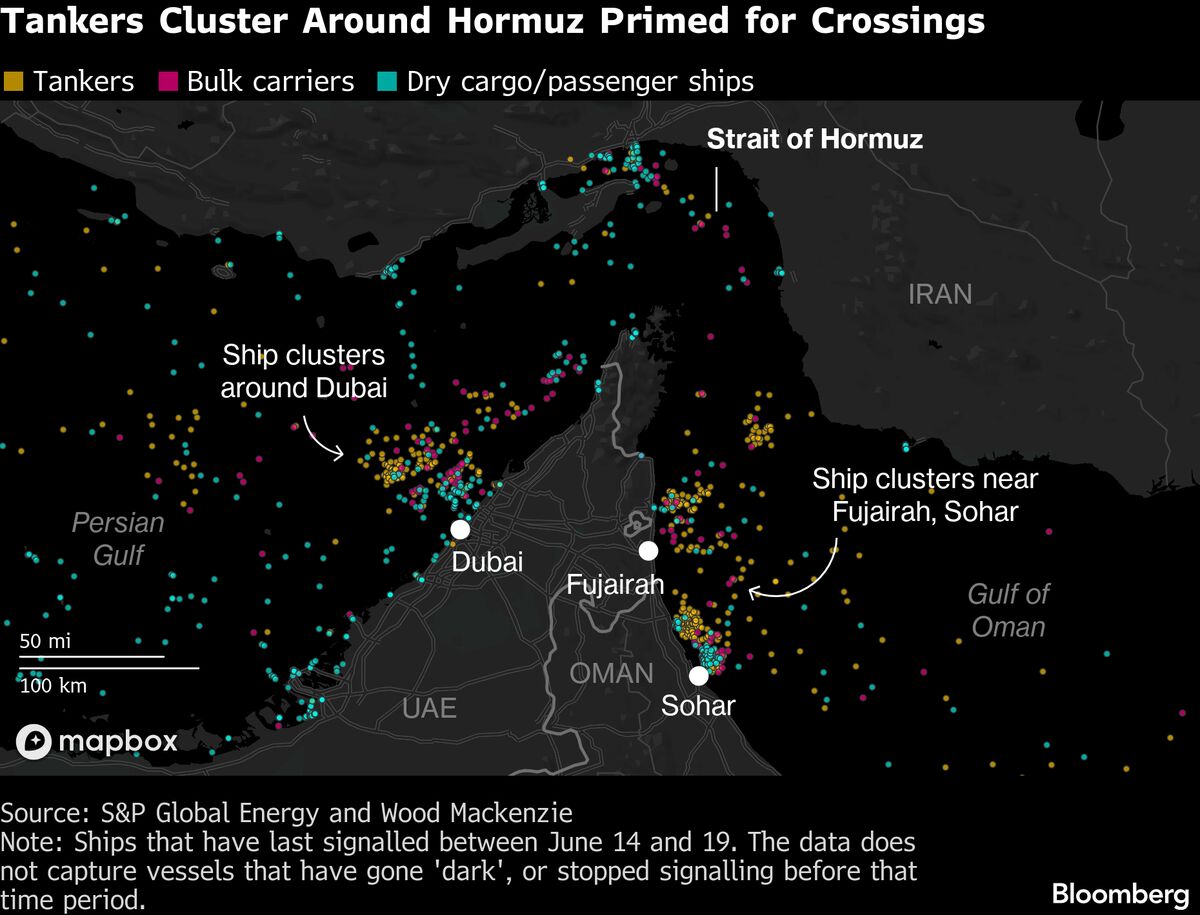
Nearly 80 million barrels of oil sit in supertankers ready to transit the Strait of Hormuz, pending trader and shipowner approval.
<p>A massive flotilla of supertankers carrying close to 80 million barrels of crude oil is anchored in the Persian Gulf, poised to move through the Strait of Hormuz the moment commercial and logistical conditions align, according to <a href='https://www.bloomberg.com/news/articles/2026-06-19/supertankers-with-80-million-barrels-of-oil-ready-to-pass-hormuz'>Bloomberg Markets</a>. The scale of this waiting cargo underscores the acute tension between global oil supply chains and the geopolitical chokepoint that handles roughly one-fifth of the world's seaborne crude. For traders and investors, the timing and pace at which this volume eventually clears Hormuz could carry meaningful implications for near-term oil prices, freight rates, and regional risk premiums.</p><h2>Table of Contents</h2><ul><li><a href='#scale'>The Scale of Waiting Cargo</a></li><li><a href='#hormuz'>Why the Strait of Hormuz Matters</a></li><li><a href='#market-impact'>Potential Market Impact</a></li><li><a href='#freight'>Freight and Tanker Rate Dynamics</a></li><li><a href='#outlook'>Outlook and Trader Considerations</a></li></ul><h2 id='scale'>The Scale of Waiting Cargo</h2><p>Nearly 80 million barrels of oil held aboard supertankers in the Persian Gulf represents a significant concentration of floating supply. To put that figure in context, global oil consumption runs at roughly 100 million barrels per day, meaning this single cluster of vessels holds close to a full day's worth of worldwide demand. The sheer volume suggests that producers and traders have been accumulating cargo, either in anticipation of favorable transit conditions, improved pricing windows, or a resolution to whatever friction is currently delaying passage.</p><p>Supertankers — formally classified as Very Large Crude Carriers (VLCCs) or Ultra Large Crude Carriers (ULCCs) — are the workhorses of long-haul oil trade. Each vessel can carry between 2 million and 3 million barrels, meaning the current backlog likely involves dozens of ships. When a cluster of this magnitude moves simultaneously, it can create a measurable pulse in global supply availability, affecting both spot prices and forward curves.</p><h2 id='hormuz'>Why the Strait of Hormuz Matters</h2><p>The Strait of Hormuz is one of the most strategically critical maritime passages on the planet. Connecting the Persian Gulf to the Gulf of Oman and the broader Arabian Sea, it serves as the primary export corridor for crude oil from Saudi Arabia, Iraq, Iran, Kuwait, the United Arab Emirates, and Qatar. Any disruption — whether from military conflict, sanctions enforcement, or navigational hazards — has historically triggered immediate spikes in oil prices and insurance premiums.</p><p>The fact that traders and shipowners are described as needing to give the explicit go-ahead before these vessels transit suggests that risk calculus is actively in play. Commercial operators weigh war-risk insurance costs, potential sanctions exposure, and the threat of vessel seizure or interdiction when deciding whether to authorize a Hormuz crossing. When that authorization is withheld, cargo piles up — exactly the scenario Bloomberg Markets is reporting.</p><p>Even under normal geopolitical conditions, the strait's narrow navigable channels — roughly two miles wide in each direction — create natural bottlenecks. A sudden surge of dozens of laden supertankers seeking passage simultaneously could create logistical congestion, further complicating transit timelines.</p><h2 id='market-impact'>Potential Market Impact</h2><p>The market implications of this waiting cargo are layered. On one hand, the existence of nearly 80 million barrels ready to flow represents latent supply that, once released, could weigh on crude prices — particularly if it arrives in destination markets during a period of already-adequate inventory levels. Brent crude and WTI traders should monitor any signals that transit authorizations are being granted en masse, as a coordinated release could pressure the front end of the futures curve.</p><p>On the other hand, the very fact that this cargo is bottled up reflects an underlying risk premium embedded in current prices. If the delay is driven by genuine security concerns around Hormuz, then the market may not be fully pricing the tail risk of a more serious disruption. A scenario in which transit is blocked entirely — rather than merely delayed — would be sharply bullish for oil, potentially driving prices significantly higher as buyers scramble for alternative supply routes or storage solutions.</p><p>Refinery margins and product markets could also be affected. Refiners in Asia and Europe that depend on Persian Gulf crude for feedstock would face tightening supply if the backlog persists, potentially lifting crack spreads for middle distillates and gasoline in the near term.</p><h2 id='freight'>Freight and Tanker Rate Dynamics</h2><p>For participants in the tanker market, the current situation presents a complex set of signals. A large number of VLCCs sitting idle in the Persian Gulf effectively removes those vessels from the active trading fleet for the duration of the delay. This tightening of available tonnage can push spot freight rates higher on other trade routes, as charterers compete for the remaining available ships.</p><p>Conversely, when the logjam breaks and dozens of supertankers begin moving simultaneously, the subsequent wave of vessel availability — once those ships discharge their cargo and return to the market — could temporarily soften freight rates. Tanker investors and shipowners with vessels positioned in the region will need to weigh the timing of their own chartering decisions carefully against this backdrop.</p><p>War-risk insurance premiums, which are charged as a surcharge on top of standard marine insurance for vessels transiting high-risk zones, are another variable to watch. Elevated premiums increase the effective cost of moving Persian Gulf crude, which can widen the discount at which regional grades trade relative to international benchmarks.</p><h2 id='outlook'>Outlook and Trader Considerations</h2><p>The central question for market participants is what catalyst will finally prompt traders and shipowners to authorize the transit of this waiting cargo. Possibilities include a diplomatic development that reduces perceived risk in the strait, a shift in sanctions enforcement posture, a sufficiently attractive arbitrage opportunity that justifies the elevated risk premium, or simply the passage of time without incident that emboldens commercial operators to proceed.</p><p>Until that catalyst materializes, the 80 million barrels of floating supply represents both a potential source of price relief and a barometer of geopolitical stress in one of the world's most sensitive energy corridors. Traders with exposure to crude oil, refined products, or tanker equities should treat developments around Hormuz transit conditions as a high-priority monitoring item in the days and weeks ahead.</p><p>For full details and ongoing coverage, readers are encouraged to consult the original <a href='https://www.bloomberg.com/news/articles/2026-06-19/supertankers-with-80-million-barrels-of-oil-ready-to-pass-hormuz'>Bloomberg Markets report</a>.</p><h2>Conclusion</h2><p>Nearly 80 million barrels of crude oil sitting in supertankers at the mouth of the Strait of Hormuz is not a routine market footnote — it is a signal of significant commercial hesitation at one of the world's most consequential energy chokepoints. Whether this cargo flows freely or remains bottled up will have direct consequences for oil prices, tanker rates, and regional risk premiums. Traders should position accordingly and watch closely for any shift in the authorization posture of shipowners and commercial operators in the Persian Gulf.</p> <p><a href="https://www.bloomberg.com/news/articles/2026-06-19/supertankers-with-80-million-barrels-of-oil-ready-to-pass-hormuz" rel="nofollow noopener noreferrer" target="_blank">Read original source</a></p>