education
Trading Community vs Signal Groups
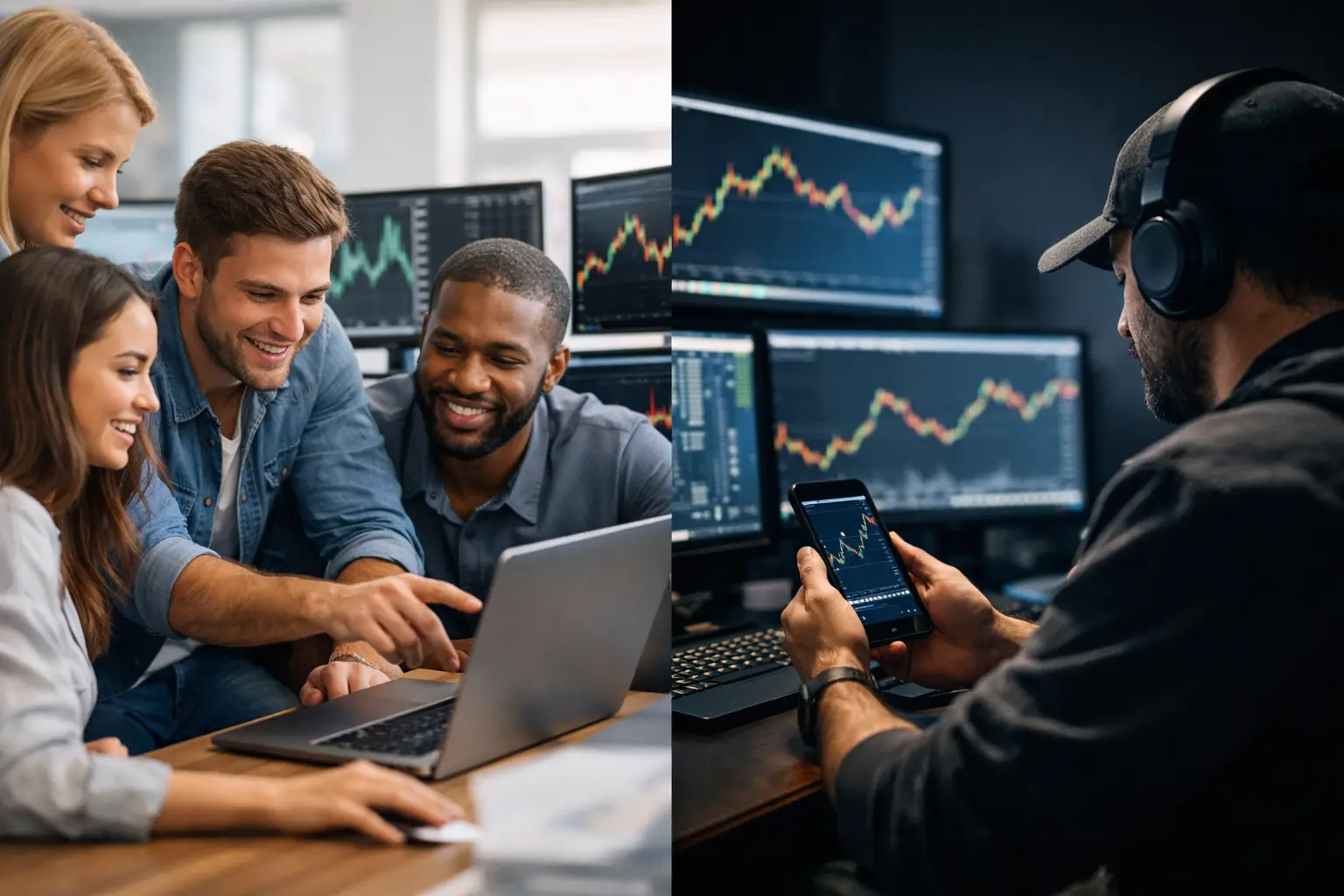
Trading community vs signal groups: learn which model builds trust, skill, and better decision-making for stock, crypto, and forex traders.
A Telegram room posts a buy alert, the chart moves, screenshots start flying, and everyone who missed the entry is already late. That is usually where the real debate around trading community vs signal groups begins - not in theory, but in the gap between fast information and informed decision-making.
For active traders, that gap matters. A signal can tell you what someone else is doing. A real trading community can show you why, how, when conditions change, and whether the idea still holds after the first burst of momentum fades. Those are not small differences. They shape trust, risk control, and long-term performance.
Trading community vs signal groups: what is the actual difference?
A signal group is typically built around distribution. One person, or a small team, sends trade alerts to a larger audience. The value proposition is speed and convenience. Members join because they want entries, exits, targets, and sometimes stop-loss levels without doing the full research themselves.
A trading community is built around participation. Ideas move in multiple directions, not one. Members discuss setups, challenge assumptions, share research, compare market conditions, and often bring different strengths to the table. One trader may be strong in macro, another in technical structure, another in options flow, and another in risk management. The result is not just a callout feed. It is an intelligence network.
That distinction becomes more important as markets get faster and noisier. In crypto, forex, and equities alike, static alerts can age badly within minutes. A community with context can adapt. A signal group without context often turns into a delayed notification service.
Why signal groups attract traders in the first place
Signal groups solve a real problem. Many traders are overloaded. They are monitoring multiple markets, balancing work or family responsibilities, and trying to interpret headlines, price action, and sentiment all at once. A concise alert feels efficient.
There is also a psychological appeal. Signals reduce uncertainty at the moment of action. Instead of facing a blank screen, the trader sees a clear suggestion. That can feel especially useful for beginners who are still learning how to structure a trade.
Some signal providers are disciplined, experienced, and genuinely useful. If the methodology is clear and performance is transparent, a signal service can act as a research input. It may help traders spot opportunities they would have missed on their own.
The problem is that many groups stop there. They provide outputs without process, claims without verification, and selective win screenshots without a full record of losses, sizing, or changing market conditions. That is where convenience starts to become dependency.
Where signal groups usually break down
The first issue is opacity. In many signal environments, the audience has very little visibility into the provider's real track record, execution quality, or risk framework. Was the trade actually taken? At what size? Was the posted entry realistic, or was it published after the move started? Without transparency, a signal can look precise while hiding weak discipline.
The second issue is market timing. Alerts travel slower than price. By the time a large group receives the same trade, early entrants may already be taking profit while late followers absorb worse entries. In volatile products, that slippage can completely change the risk-reward profile.
The third issue is skill stagnation. If traders spend too much time copying decisions, they often build less conviction, not more. When a trade wins, they may not fully understand why. When it loses, they have no framework for adjusting. That creates a fragile trading process built on borrowed confidence.
There is also a trust problem. The online trading world is crowded with anonymous operators, cherry-picked results, and marketing designed to sell certainty. Serious traders know that any financial edge worth following should stand up to scrutiny.
Why a trading community compounds value over time
A strong trading community develops judgment, not just reaction speed. Instead of only receiving a trade idea, members see the reasoning behind it, the disagreement around it, and the conditions that could invalidate it. That is how traders build repeatable decision-making.
Communities also create a more resilient feedback loop. When market conditions shift from trending to choppy, from low-volatility to headline-driven, members can compare what is working across assets and timeframes. That kind of distributed intelligence is hard to replicate in a one-way signal channel.
The best communities do something even more important: they create accountability. Traders who share ideas publicly, explain their thesis, and operate in a transparent environment are more likely to refine their process. Reputation starts to matter. Quality rises when participants know their analysis can be evaluated in context.
This is where platform design matters. A modern trading network should not just host conversation. It should support verified participation, measurable reputation, market analytics, and a structure where insight can be examined rather than merely consumed. That is a more credible model for traders who care about trust.
Trading community vs signal groups for beginners
For beginners, signal groups can feel easier at first. There is less friction. Someone else appears to do the hard part. But easy is not always useful.
A beginner usually needs three things: education, context, and a safe way to learn risk. Signal groups often deliver the least durable of the three. They may provide action, but not understanding. That can create early wins without a foundation, which is one of the fastest ways to learn the wrong lesson in trading.
A well-structured community is generally better for newer participants because it exposes them to process. They can observe how traders build a thesis, how they manage uncertainty, and how they respond when a setup fails. That kind of visibility shortens the learning curve in a healthier way.
That said, beginners can still get lost in communities if the environment is noisy, unmoderated, or full of low-quality opinions. Community is not automatically better. It has to be curated, credible, and built around signal quality in the broader sense of the word, not just alert frequency.
Trading community vs signal groups for experienced traders
More advanced traders usually need less hand-holding and more edge refinement. For them, the biggest weakness of signal groups is not quality alone. It is narrowness. A static stream of entries and exits rarely helps an experienced trader improve execution, portfolio construction, or cross-market awareness.
A high-quality trading community can. It can surface new frameworks, challenge existing bias, and expose traders to tools or data they are not currently using. It can also help them pressure-test ideas before capital is deployed.
Experienced traders are also more likely to value transparency over hype. They know that performance claims without verification are close to useless. They want to see how insight connects to actual behavior, not just marketing language. That is why trust-centered financial platforms are gaining relevance. The market no longer needs more noise. It needs better infrastructure for evaluating credibility.
What to look for before joining either one
If you are choosing between a community and a signal service, the right question is not which one sounds more profitable. The right question is which one improves your decision quality.
Look at transparency first. Can you assess who is posting, how they think, and whether their results are verifiable? Then look at context. Are ideas explained clearly enough that you can learn from them, or are they just dropped into a feed and forgotten? Finally, look at alignment. Does the environment reward education, discipline, and reputation, or does it reward attention and speed alone?
A modern platform that combines discussion, analytics, market intelligence, and verified identities has a structural advantage here. It reduces the distance between research, execution, and accountability. That matters because fragmented workflows are one of the biggest reasons traders make poor decisions. When insight, conversation, and performance visibility live in separate places, trust breaks down.
This is also why newer fintech ecosystems are moving beyond the old signal-room model. Traders increasingly want a connected environment where they can analyze markets, track portfolios, evaluate ideas, and interact with credible participants in real time. Tyrian Trade reflects that shift toward a more transparent and intelligence-driven market experience.
The better question is not signals or community
For serious market participants, the real choice is not between getting alerts and having conversations. It is between outsourcing judgment and building it.
Signals can still have a place. They can be useful as one input in a broader workflow, especially when they come from transparent, credible sources. But on their own, they rarely create durable trading capability.
A real trading community does more. It helps traders sharpen process, validate research, improve risk decisions, and learn in public without relying on blind trust. In markets where speed is common but credibility is rare, that difference is more than a feature. It is an edge.
If a platform or group helps you think more clearly, verify more confidently, and act with better context, you are probably in the right place.