education
Trading Workflow Management That Actually Scales
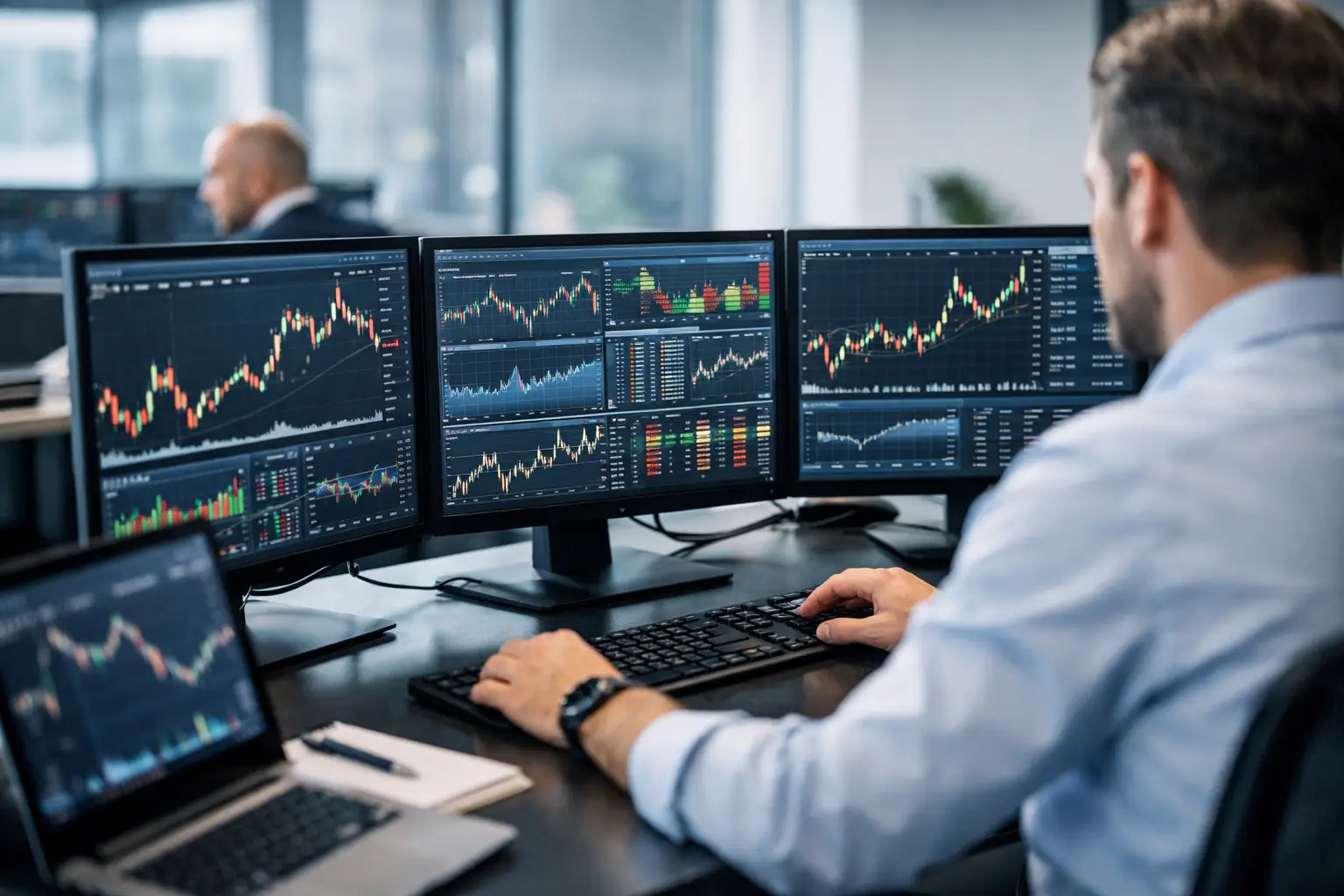
Trading workflow management helps traders unify research, execution, analytics, and collaboration into one faster, more trusted market process.
A missed entry rarely starts with the chart. It usually starts earlier - in a fragmented process. One tab holds your watchlist, another has news, a third tracks positions, and your trade journal lives somewhere else entirely. By the time conviction forms, timing is gone. That is why trading workflow management matters. It is not back-office admin for traders. It is the operating system behind better decisions, faster execution, and more accountable performance.
For active traders and self-directed investors, the market is no longer just a stream of prices. It is a constant flow of data, signals, community input, macro events, portfolio exposure, and platform-specific tools. The challenge is not access. The challenge is orchestration. When your workflow is disjointed, even good analysis can produce inconsistent outcomes.
What trading workflow management really means
Trading workflow management is the structured coordination of everything that happens before, during, and after a trade. That includes research, idea generation, validation, execution, risk controls, monitoring, journaling, performance review, and collaboration. The goal is simple: reduce friction between insight and action while preserving discipline.
In practical terms, this means a trader should not need to rebuild context every time they move from one task to another. If you spot a setup in a community feed, research the asset, compare it against your portfolio exposure, assess sentiment, execute the trade, and later review the result, each step should connect cleanly. When those steps are isolated across disconnected tools, mistakes multiply. Position sizing gets rushed. Notes go missing. Attribution becomes weak. Patterns in performance stay hidden.
That is why workflow management is not just about efficiency. It is also about trust in your own process. Serious traders need to know not only what worked, but why it worked, under what conditions, and whether the result can be repeated.
Why fragmented workflows cost more than time
Most traders first notice workflow problems as an inconvenience. Over time, they become a structural edge for better-organized participants. A fragmented workflow creates three direct costs.
The first is execution drift. You may begin with a clear thesis, but if market data, social context, and portfolio analytics sit in different environments, the trade can change as you move through the process. Entries become reactive. Exits become emotional. Risk management becomes inconsistent.
The second is weak accountability. If your journal is incomplete or disconnected from actual market conditions and execution data, post-trade review turns into storytelling. You remember the trade emotionally instead of analyzing it accurately. That makes improvement slower than it should be.
The third is information quality. Modern traders consume ideas from everywhere - charting platforms, social feeds, private groups, AI tools, market scanners, and news alerts. Not all of that information is credible. Without a workflow that prioritizes verification and context, noise can look like signal.
This is where a trust-centered trading environment matters. In a connected ecosystem, market ideas, trader identity, analytics, and execution context can reinforce each other instead of competing for attention.
The core layers of a modern trading workflow management system
A usable workflow is not just a checklist. It is a connected structure. For most active traders, five layers matter.
Research comes first. This is where market themes, catalysts, technical setups, sentiment shifts, and macro conditions begin to form a thesis. Good research workflow design reduces context switching. You want market intelligence, asset discovery, and community signal flow close enough to evaluate quickly, but not so compressed that everything feels equally urgent.
Decision support is the second layer. This is where many traders underinvest. A setup may look attractive on its own but become less attractive once portfolio concentration, correlation, volatility, or event risk is factored in. The stronger your analytics layer, the less likely you are to confuse a good chart with a good trade.
Execution is the third layer. This includes order placement, timing, trade sizing, and rule enforcement. Fast execution matters, but disciplined execution matters more. If your workflow cannot carry your plan into the order stage without friction, you are inviting discretionary mistakes.
Monitoring is the fourth layer. Once a position is live, traders need a clear view of price behavior, changing market conditions, and exposure across accounts or asset classes. Monitoring is not about staring at the screen all day. It is about receiving the right signals at the right time.
Review is the fifth layer. This is where the workflow pays off. Trade data, notes, rationale, outcomes, and behavioral patterns need to be recorded in a way that supports iteration. Without review, even a busy trader stays operationally immature.
How better trading workflow management improves decision quality
The strongest workflows do not just save time. They improve thinking.
When research, execution, and review are connected, traders begin to identify recurring strengths and recurring failure points with more precision. Maybe your breakout trades perform well only when broader market breadth confirms. Maybe your crypto entries work at specific volatility levels. Maybe your best ideas come from a certain type of catalyst, while your worst trades come from social momentum with no deeper validation. A connected workflow makes these patterns visible.
It also reduces cognitive overload. Traders perform poorly when they have to remember too much process in real time. If your system automatically carries forward watchlists, notes, exposure metrics, prior performance data, and relevant market context, you spend less energy reconstructing the trade and more energy evaluating it.
This matters across experience levels. Beginners need structure because they lack repetition. Advanced traders need structure because scale exposes every inefficiency. More positions, more markets, and more data do not just increase opportunity. They increase the probability of process decay.
Trading workflow management in a social and AI-driven market
Markets are now shaped by more than price charts and economic calendars. Real-time discussion, trader reputation, AI-assisted analysis, and shared market intelligence all influence how opportunities are discovered and validated. That changes workflow design.
A modern workflow should not treat community input as separate from analysis. It should treat community as a filterable signal source. The key is verification. Anonymous opinions with no track record create more noise than value. Verified participation, visible history, and transparent discussion make social input more usable.
AI also changes the workflow, but not by replacing judgment. Its value is speed, pattern recognition, and compression. AI can surface anomalies, summarize market conditions, highlight correlations, and help traders process more information in less time. The trade-off is obvious: faster intelligence is only helpful if the inputs are credible and the user knows how to challenge the output.
That is why connected trading infrastructure matters. A platform like Tyrian Trade is built around this exact problem - bringing together market intelligence, analytics, community participation, portfolio visibility, and trading tools inside a more coherent environment. For traders trying to reduce fragmentation, that model is directionally right because it treats workflow as infrastructure, not as an afterthought.
What to look for in trading workflow management tools
Not every all-in-one platform actually improves workflow. Some simply stack features in one place. The difference is integration quality.
A useful system should preserve context from idea to execution to review. It should support portfolio-level visibility, not just single-trade analysis. It should make it easier to validate information quality, especially in social environments. And it should help traders compare intention versus outcome, because that gap is where improvement happens.
There is also a trade-off between flexibility and discipline. Highly customizable workflows can fit advanced users well, but they can also create complexity that weaker habits cannot sustain. More guided systems can be valuable for newer traders, though some experienced users may find them restrictive. The right setup depends on trading frequency, asset coverage, strategy complexity, and whether you work independently or rely on collaborative market input.
Building a workflow that holds up under pressure
The best time to design a trading process is when the market is quiet. The best test of that process is when the market is moving fast.
If you are evaluating your own workflow, start by tracing your last ten trades from idea source to final review. Look for breaks in continuity. Where did context get lost? Where did execution drift from the original plan? Where did review rely on memory instead of data? Those breaks are usually more revealing than the trade outcomes themselves.
A strong workflow does not make every trade profitable. It makes your process legible. It gives you a clearer line between signal and noise, analysis and reaction, confidence and overconfidence. In markets defined by speed and information overload, that clarity is not a luxury. It is part of the edge.
The traders who last are rarely the ones with the most inputs. They are the ones with the cleanest operating system for turning inputs into decisions.