education
What a Crypto Trading Community App Should Do
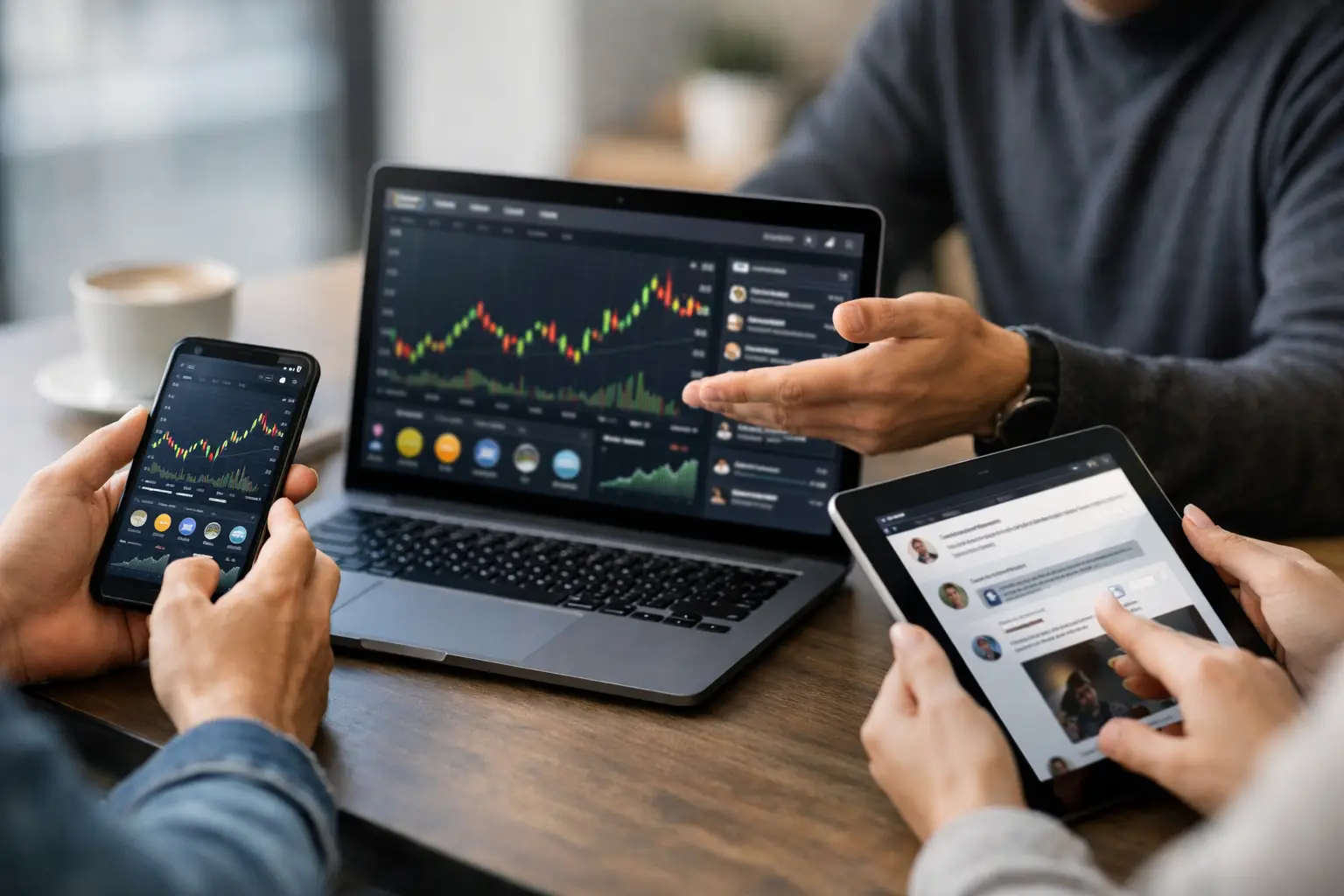
See what a crypto trading community app should actually deliver - verified traders, real-time insight, analytics, and trust built into every workflow.
Most traders do not need more crypto content. They need a better signal environment. That is the real test of a crypto trading community app - not how many posts it can surface, but whether it helps users separate credible market intelligence from recycled noise, hype, and anonymous performance claims.
Crypto moves fast, but speed alone does not create edge. In practice, traders lose time bouncing between exchanges, social feeds, charting tools, portfolio trackers, chat groups, and research dashboards that were never designed to work together. The result is a fragmented workflow where decisions happen across disconnected tabs, and trust is usually the weakest part of the stack.
A serious platform in this category should do more than host discussion. It should combine community, analytics, verified participation, and real-time market context inside one operating layer. That shift matters because crypto trading is no longer just about finding information first. It is about finding credible information in time to act on it.
Why a crypto trading community app matters now
The old model was simple: traders sourced ideas from one place, charts from another, execution somewhere else, and portfolio visibility from a separate tool. That model still exists, but it creates friction at exactly the moments when timing and clarity matter most.
Crypto amplifies that problem. Markets trade around the clock, narratives rotate quickly, and sentiment can push price before fundamentals are fully understood. In that environment, community can be powerful, but only if it is structured around transparency. Otherwise, the same network effects that make communities useful also make them vulnerable to manipulation, herd behavior, and low-quality advice.
A strong crypto trading community app turns community from a hype layer into an intelligence layer. It gives traders context around who is speaking, what data supports the view, how ideas are performing, and whether the conversation is connected to actual market activity. That is a different standard than the typical feed-based product.
What separates a real platform from a chat room
Many products in this space look similar on the surface. They have profiles, comment threads, watchlists, and alerts. The difference is in the architecture underneath.
A useful trading community app should not treat conversation as a standalone feature. Discussion becomes more valuable when it is tied to market structure, portfolio analytics, chart behavior, and trader reputation. If someone shares a thesis on Bitcoin, Solana, or a breakout setup in an altcoin, the surrounding system should help users evaluate that idea in context rather than just react to it.
That means identity and verification matter. So does transparency around track records, historical calls, engagement quality, and participation patterns. Anonymous commentary is not always worthless, but for serious traders, credibility improves when signal is attached to observable behavior.
This is where many platforms fall short. They optimize for activity, not reliability. They reward visibility, not accuracy. Over time, that creates crowded feeds with weak accountability. A better model puts trust infrastructure closer to the center.
Verified participation changes the quality of signal
Verification is not just a compliance feature or a branding detail. In a trading environment, it directly affects decision quality. When users can assess whether contributors are credible, active, and consistent, community becomes more than entertainment.
That does not mean every trader must be public or institutional. It means the platform should create mechanisms that make reputation earned rather than claimed. Verified participation, transparent performance context, and visible engagement history all help reduce the usual gap between online confidence and actual trading competence.
For newer traders, this creates a safer learning environment. For experienced users, it improves filtering. Both groups benefit when the system rewards evidence over attention.
The best crypto trading community app is part research terminal, part social layer
Traders do not operate in clean categories. Research, discussion, execution planning, and portfolio monitoring are connected. A platform built for modern market participants should reflect that reality.
The strongest experience usually combines several capabilities in one environment. Real-time discussions help traders respond to emerging moves. Analytics and AI-assisted market intelligence help them test whether a narrative has substance. Portfolio tools show exposure and performance across positions. Educational content supports users who are still building process and risk discipline.
When those elements live together, community becomes more actionable. A market idea can move from discussion to validation to decision support without forcing the user to leave the ecosystem. That does not guarantee profitable trades, and no platform should imply otherwise. But it reduces workflow drag, which is often underestimated.
AI can improve judgment - if it is used correctly
AI has become a common claim in trading software, but the value depends on how it is applied. Traders do not need generic automation layered over market noise. They need tools that help surface relevant patterns, organize large volumes of information, and identify relationships faster than manual scanning alone.
In a crypto trading community app, AI is most useful when it strengthens human decision-making rather than replacing it. That can mean highlighting unusual activity, clustering sentiment shifts, identifying repeated setups across markets, or helping traders monitor portfolios and watchlists with more precision.
The trade-off is obvious. More intelligence can create more confidence, but confidence is not the same as certainty. AI-generated insight still needs market context, risk control, and human interpretation. A credible platform treats AI as an analytical advantage, not a substitute for discipline.
Community without transparency creates expensive mistakes
There is a reason many traders become skeptical of online trading communities. Too many are built around screenshots, selective memory, and recycled narratives presented as expertise. In crypto, where volatility and social momentum are tightly linked, that creates real risk.
A better standard starts with transparency at the platform level. Users should be able to understand who they are interacting with, what kind of content is being surfaced, and how reputation is formed. They should also be able to move from public discussion into deeper analysis without losing continuity.
This matters for more than safety. It improves market discovery. When the community is structured around verified participation and observable behavior, high-quality contributors become easier to identify. That makes the entire network more useful, especially during fast-moving conditions when traders cannot afford to sort through noise manually.
Why unified infrastructure matters for active traders
The most overlooked feature in this category is not a feed, a chart, or a social graph. It is integration.
Active traders often patch together their own stack because no single product covers everything well. That can work, but it comes with friction: missed alerts, duplicate workflows, inconsistent data, and a constant context switch between tools. Over time, this slows execution and weakens situational awareness.
A modern platform should reduce that fragmentation. Community, analytics, live market monitoring, portfolio visibility, educational content, and access to trading tools should feel connected. Not because consolidation is trendy, but because connected systems improve speed, clarity, and continuity.
This is where a next-generation platform such as Tyrian Trade fits the market well. The value is not just in adding social features to trading. It is in building a trusted financial intelligence environment where verified community participation, AI-powered analysis, portfolio tools, and market infrastructure work together.
Choosing the right crypto trading community app
Not every trader needs the same product. Beginners may prioritize education, guided analysis, and a cleaner path to trusted insight. Advanced users may care more about reputation systems, research depth, real-time collaboration, and analytics that support active positioning. Long-term investors may value portfolio visibility more than chat velocity.
Still, a few standards are universal. The app should help users evaluate signal quality, not just consume more content. It should reduce fragmentation rather than add another disconnected layer. It should create accountability inside the community. And it should support better market awareness without pretending to remove risk.
That last point matters. No platform can eliminate bad decisions, false breakouts, crowded trades, or emotional behavior. Markets will stay uncertain. Volatility will stay part of crypto. What the right platform can do is give traders a more credible operating environment - one where information, reputation, analytics, and community are aligned instead of scattered.
For traders who are serious about process, that is the real opportunity. The next wave of trading platforms will not win by being louder. They will win by being more trusted, more connected, and more useful at the exact moment a decision has to be made.
If a crypto trading community app cannot help you judge credibility, track context, and act with more clarity, it is probably just another feed. Serious traders need more than access. They need infrastructure they can trust.