education
What an AI Powered Trading Assistant Does
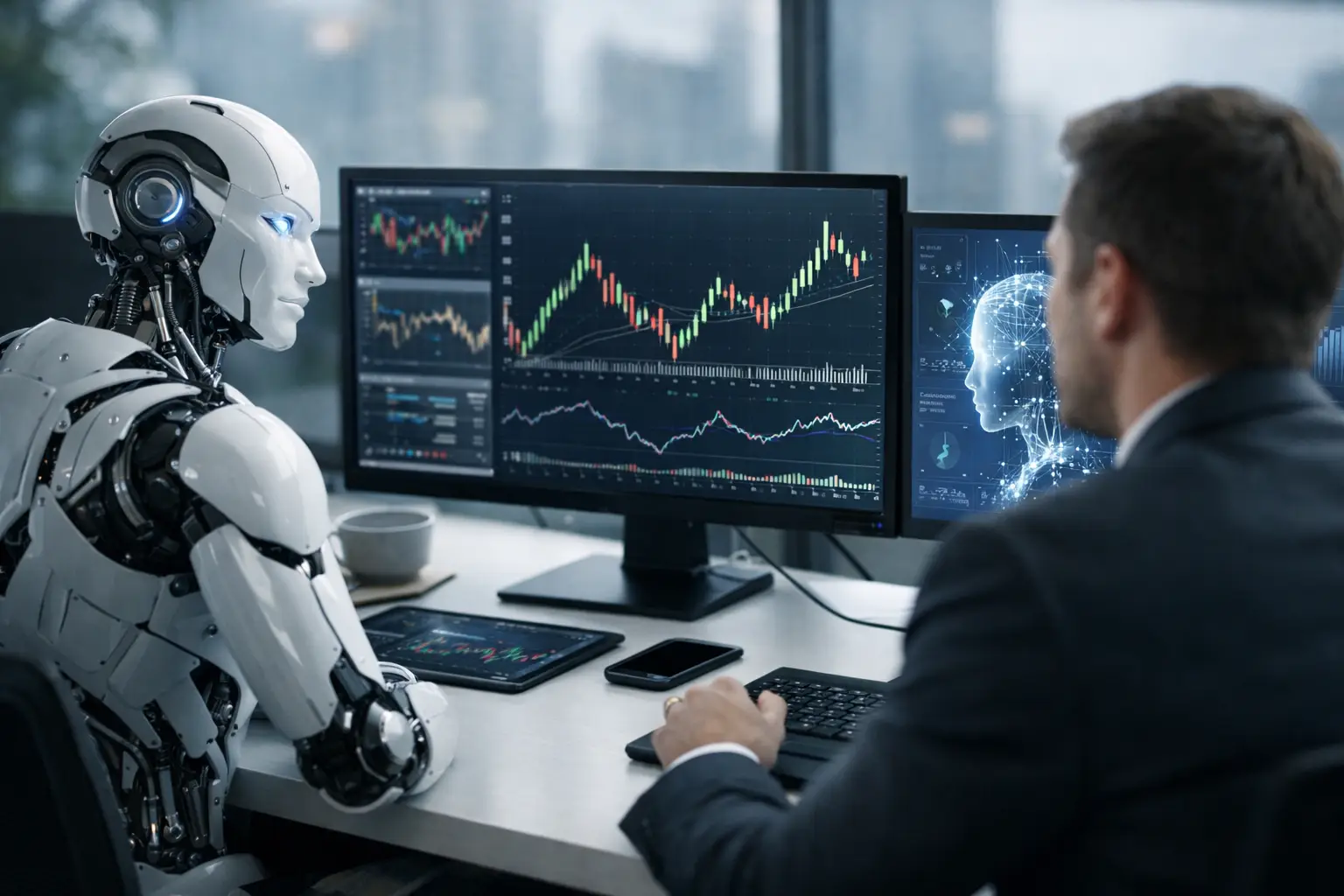
See how an ai powered trading assistant helps traders analyze markets, manage risk, filter noise, and make faster, smarter decisions.
Markets do not slow down because your workflow is fragmented. Price moves, sentiment shifts, macro headlines hit, and by the time most traders have checked three apps, two charts, and a crowded social feed, the opportunity has already changed. That is where an ai powered trading assistant starts to matter - not as a replacement for judgment, but as a system for reducing lag between information, analysis, and action.
For active traders and self-directed investors, the real problem is rarely access to data. It is sorting signal from noise fast enough to use it. A modern trading stack can include charting software, broker tools, news feeds, portfolio trackers, Discord groups, research terminals, and social platforms that may or may not be credible. The result is a market experience that feels connected on the surface and deeply broken underneath. An AI assistant becomes valuable when it brings these moving parts into a more intelligent, transparent workflow.
What an AI powered trading assistant actually is
An ai powered trading assistant is best understood as a decision-support layer built on top of trading activity, market data, and user behavior. It does not need to place trades autonomously to be useful. In many cases, its best role is narrower and more practical: surfacing relevant setups, identifying unusual market behavior, tracking portfolio exposure, interpreting patterns across assets, and helping traders act on verified information rather than market theater.
That distinction matters. Many products in trading are marketed as if AI can simply generate alpha on demand. Serious traders know better. Markets are adaptive, crowded, and often irrational. The stronger use case for AI is not magic prediction. It is contextual intelligence.
A good assistant can recognize that you trade large-cap momentum, short-term crypto rotations, or forex around macro events, then adapt what it shows you. It can prioritize the information that matches your style instead of flooding you with generic alerts. It can also connect analysis to performance, which is where many traders still operate in the dark.
Why traders are shifting toward AI-assisted workflows
The shift is less about hype and more about structure. Traders are under pressure to process more information in less time, while also protecting themselves from misinformation, copycat narratives, and low-quality trade ideas. In that environment, speed alone is not enough. The quality of interpretation matters just as much.
An AI assistant helps by compressing research time. It can monitor multiple assets, compare current price behavior with historical patterns, flag momentum changes, or identify correlations that a trader may miss during fast market conditions. Used well, this does not create dependence. It creates bandwidth.
There is also a trust angle. Online trading communities have grown quickly, but credibility has not grown at the same rate. Unverified claims, edited screenshots, recycled analysis, and performance exaggeration have made it harder to know who to listen to. AI becomes more useful when paired with transparent infrastructure, verified activity, and reputation signals. Without that foundation, even smart analysis can sit inside a low-trust environment.
The most useful jobs an AI assistant can handle
The strongest ai powered trading assistant is not the one making the boldest promises. It is the one that improves the actual workflow of a trader across research, execution prep, and review.
Market monitoring is one of the clearest examples. Instead of manually scanning dozens of symbols, traders can use AI to detect volatility spikes, volume anomalies, sentiment changes, and technical breaks as they emerge. That can be especially useful across fragmented markets like crypto or globally active products like forex, where important movement often starts outside a trader's preferred hours.
Trade preparation is another major use case. AI can help organize pre-trade context by combining chart structure, news impact, historical behavior, and broader sector or macro alignment. That does not make a trade correct. It makes the decision better informed.
Portfolio analytics may be even more valuable over time. Many traders think in terms of individual positions while missing concentration risk, strategy overlap, or repeated behavioral mistakes. An assistant that maps exposure, tracks performance by setup type, and identifies where losses cluster can improve discipline faster than another indicator ever will.
Then there is information filtering. Traders do not need more content. They need better ranking. AI can help distinguish between relevant market intelligence and attention bait, especially when integrated into a platform designed around verified participation and transparent market discussion.
Where AI adds edge and where it does not
There is a practical way to think about this. AI performs well when the task involves pattern recognition, prioritization, summarization, anomaly detection, and workflow automation. It performs poorly when traders expect certainty in uncertain markets.
That is why expectations matter. An assistant may identify statistically similar setups from the past, but similarity is not destiny. A clean pattern can fail because rates changed, liquidity vanished, or the market simply crowded into the same obvious trade. AI can tighten the research loop, but it cannot eliminate regime shifts or emotional decision-making.
It also depends on the trader. A beginner may benefit most from guided analysis, risk prompts, and educational explanations tied to real market movement. An experienced trader may care more about speed, customized alerts, and post-trade analytics. The same tool can feel transformative for one user and irrelevant for another if it does not match the strategy.
What to look for in an AI powered trading assistant
The first question is not how advanced the model sounds. It is whether the assistant is connected to the parts of trading that actually matter: market data, portfolio behavior, community intelligence, and execution context.
A useful system should be personalized. If every user receives the same signals, the product is not assisting a trader so much as broadcasting content. Personalization should reflect asset preference, time horizon, risk profile, and behavior over time.
Transparency is just as important. Traders need to understand why a signal, summary, or alert appeared. Black-box outputs create a new trust problem instead of solving the old one. If AI recommends attention, it should show the drivers behind that recommendation.
Verified data environments also matter. AI trained or deployed inside low-quality social ecosystems can amplify noise with impressive language. In a stronger environment, it can evaluate ideas against reputation, track record, and actual market participation. That is where a platform like Tyrian Trade has a structural advantage - AI works better when the surrounding ecosystem is built around trust rather than anonymous performance claims.
The final test is whether the assistant improves decision quality without slowing execution. If it creates more dashboards, more friction, or more confusion, it is not solving the real problem.
AI, community, and the future of trading infrastructure
The next phase of trading technology is not just smarter analytics. It is connected intelligence. Traders increasingly want one environment where they can discover opportunities, validate ideas, monitor performance, and engage with credible market participants in real time. AI is most powerful inside that broader system.
That changes the role of community as well. Social trading has often leaned too hard on visibility and not hard enough on verification. AI can strengthen community discovery by surfacing valuable contributors, identifying consistent analysis, and reducing the reach of low-trust content. Instead of making markets more noisy, it can make participation more accountable.
This also points to a more mature view of trading assistance. The goal is not to automate away thinking. It is to build better infrastructure around it. Serious traders still need judgment, risk control, and a framework for uncertainty. What AI can do is reduce operational drag and sharpen the quality of information that reaches them.
That is a meaningful shift. In fragmented markets, edge often comes from faster synthesis, better filters, and tighter feedback loops. Traders who can connect analysis, action, and review inside one intelligent environment are in a stronger position than those still stitching together disconnected tools.
The smartest way to use an AI assistant is not to ask it for certainty. It is to use it as a force multiplier for process. If it helps you see relevant opportunities sooner, understand your risk more clearly, and participate in a more transparent market environment, it is doing real work. And in modern trading, real work beats hype every time.