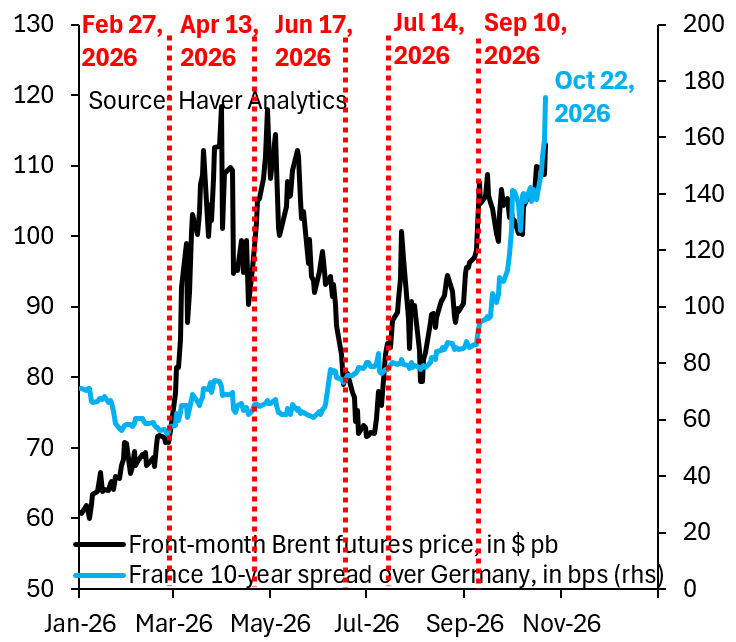
France’s Sovereign Debt Is Becoming Increasingly Sensitive to Oil Prices
One thesis behind the sudden stress in French sovereign debt is that France has become increasingly sensitive to oil prices.
When the recent MoU was signed and Brent crude moved lower, markets began pricing France as a potential beneficiary.
Lower energy prices would ease inflation pressure, reduce import costs and provide some relief to an economy already dealing with significant fiscal constraints.
That dynamic changed after the September 10 attack on the East-West pipeline.
The renewed energy shock pushed oil risk back into the market and weakened the assumption that France would benefit from a sustained decline in crude prices.
For a highly indebted country, higher energy costs can create several problems at once.
Inflation becomes harder to contain, household purchasing power comes under pressure, economic growth can weaken and government borrowing costs may remain elevated.
That helps explain why French bonds could become unusually sensitive to moves in Brent.
The relationship is not literally one-to-one, and oil is not the only factor driving French yields.
Fiscal deficits, political uncertainty, ECB policy and broader European risk sentiment still matter.
But if energy prices remain elevated, France’s already difficult fiscal position could become even harder for markets to ignore.