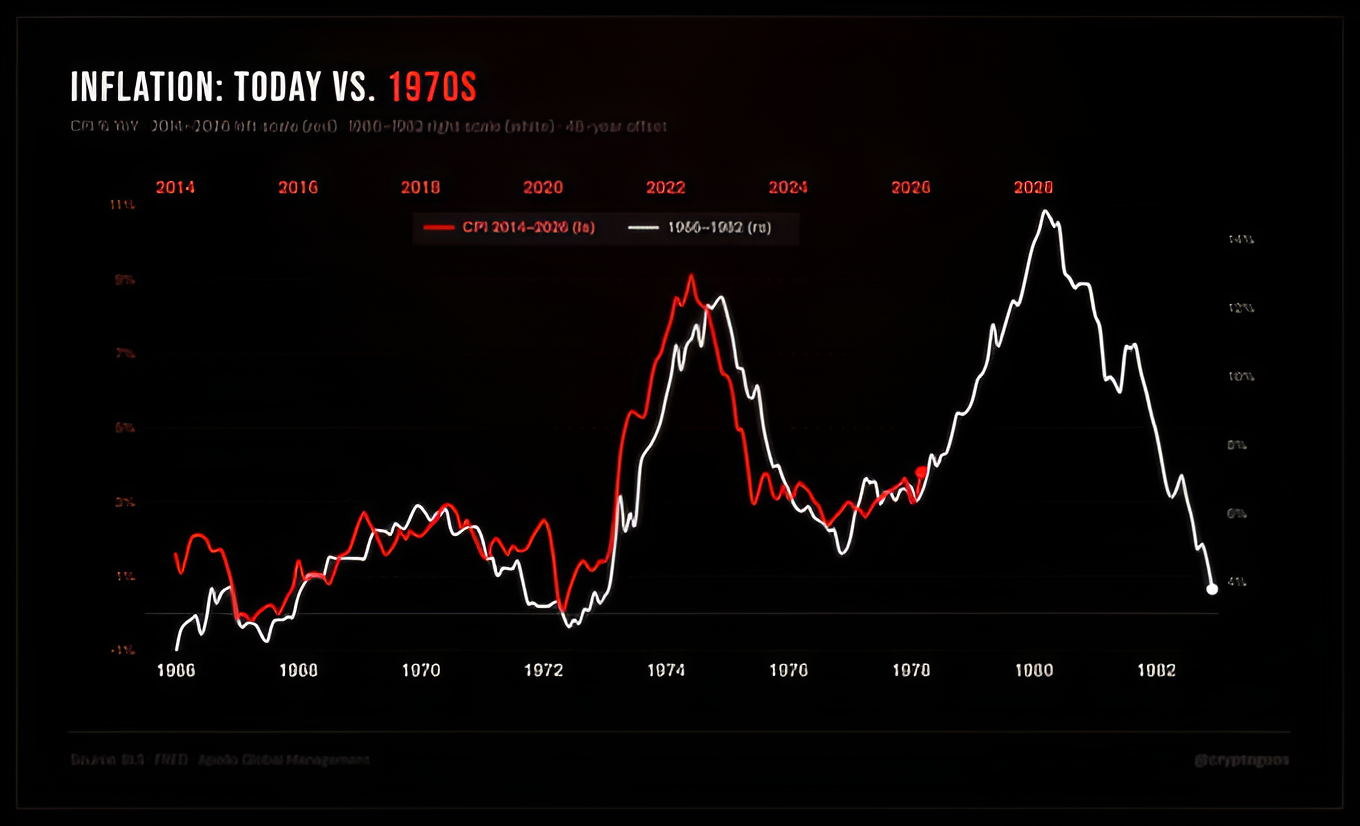
Historical Parallels: Why the 1970s "Three Waves" Inflation Cycle Haunts Today’s Markets
Historical comparisons between modern price pressures and the Great Inflation of the 1970s highlight a recurring macro risk: inflation rarely moves in a straight line, but rather in distinct, deceptive waves.
During the 1970s, markets prematurely declared victory during interim disinflationary troughs, only to face aggressive secondary surges:
• Wave 1 (1969–1970): Initial overheating peaked near 6% before cooling to ~3% by 1972, prompting premature monetary easing.
• Wave 2 (1973–1974): Energy shocks and supply disruptions drove CPI above 12%, followed by another partial cooling phase.
• Wave 3 (1979–1980): The final and most severe wave sent inflation past 14%, ultimately requiring the Volcker Fed to hike benchmark rates toward 20% to break expectations.
The macro debate today centers on whether recent headline cooling represents structural normalization or merely the trough between successive waves. While disinflationary periods lure investors into aggressive risk-taking and duration bets, persistent structural pressures—including energy transitions, geopolitical fragmentation, and rising sovereign deficits—leave balance sheets vulnerable if a secondary wave takes hold.