education
Top Features in Trading Platforms That Matter
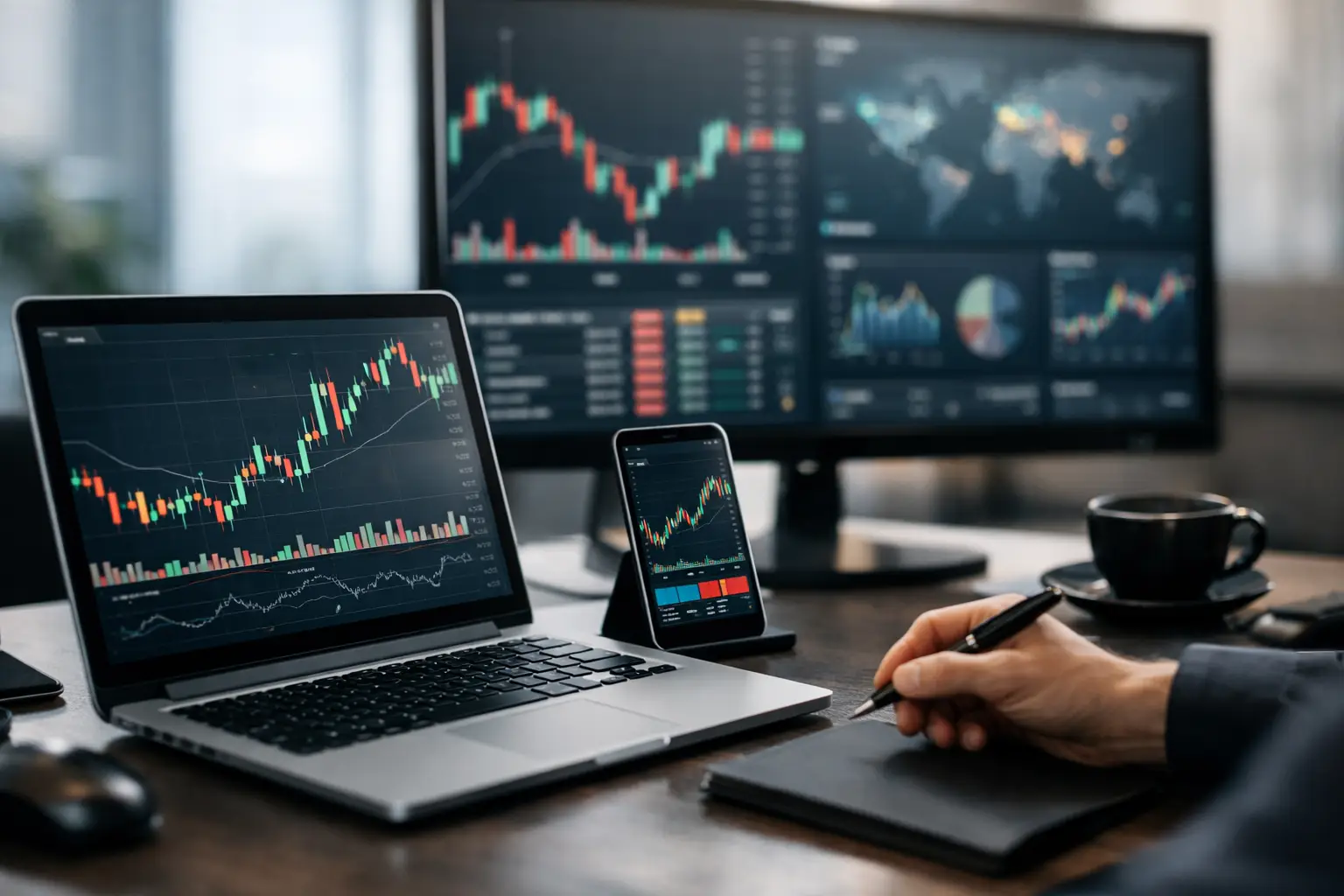
Learn which top features in trading platforms support better decisions: verified data, AI insight, portfolio analytics, execution, and community trust.
A trading platform can look polished and still leave traders working across five disconnected tabs: one for charts, another for news, a spreadsheet for portfolio exposure, and an unverified social feed for market ideas. The top features in trading platforms should reduce that fragmentation without reducing a trader's control. For active market participants, the question is no longer whether a platform offers a chart or a watchlist. It is whether its infrastructure helps turn real-time information into accountable, informed action.
The strongest platforms are built around a connected decision process: observe the market, evaluate the evidence, understand portfolio risk, execute or document a view, and learn from the outcome. Features matter most when they support that full cycle rather than operating as isolated add-ons.
Top Features in Trading Platforms for Better Decisions
Real-time market data with clear context
Speed matters, but raw speed alone is not market intelligence. A live price feed is only useful when traders can place it in context: volume behavior, volatility, market depth, sector movement, relevant news, economic events, and the performance of correlated assets.
A capable platform organizes this information around the instruments a user actually follows. Watchlists should be flexible enough to separate long-term holdings, short-term trade ideas, earnings candidates, crypto assets, forex pairs, or thematic baskets. Alerts should be precise, allowing users to react to a price level, unusual volume, technical condition, or market event without monitoring every chart manually.
There is a trade-off here. More data can create more noise. The best interfaces prioritize filtering, customization, and relevance over an endless stream of indicators. A newer investor may need a clean view of price, news, and basic performance. An experienced trader may need deeper charting, multiple time frames, order-flow signals, and cross-market monitoring. A platform should accommodate both without treating complexity as sophistication.
Advanced charting that supports a repeatable process
Charts remain central because they convert changing market behavior into a visual framework. But advanced charting is not simply a long menu of indicators. Its value comes from helping a trader test and execute a consistent process.
Useful charting tools make it easy to compare time frames, annotate levels, save layouts, apply indicators, and review prior decisions. For active traders, the ability to move quickly between a market overview and a detailed chart can be the difference between observing an opportunity and acting on outdated information. For investors, charting can clarify entry discipline, trend changes, and the relationship between an individual holding and the broader market.
The platform should also preserve context. A chart annotation that disappears after a session has limited value. Saved trade plans, notes, screenshots, and historical reviews create a record of why a position was considered. That record is essential for improving a process instead of relying on memory after a volatile week.
Portfolio analytics beyond account balances
Account value is the least informative measure of a portfolio. Traders and investors need to know what is driving returns, where risk is concentrated, and whether their positions behave as independently as they appear.
Portfolio analytics should show allocation by asset class, sector, geography, market capitalization, currency, or strategy. It should identify realized and unrealized performance, drawdowns, exposure to correlated assets, and the contribution of individual positions to overall results. A portfolio holding several technology stocks, a semiconductor ETF, and crypto assets may look diversified by ticker count while still carrying concentrated risk when growth assets sell off together.
For traders, analytics should extend to behavior. Win rate alone can mislead. A platform that tracks average gain, average loss, holding time, risk-reward patterns, and performance by setup provides more useful feedback. The goal is not to force every participant into the same methodology. It is to reveal whether their own stated strategy is producing the results they expect.
AI-powered research that explains, not merely predicts
AI has a legitimate role in trading infrastructure when it helps users organize complex information, identify meaningful changes, and investigate a market thesis faster. It is less useful when presented as a black box that promises certainty in uncertain markets.
The strongest AI-powered features synthesize relevant data into a transparent starting point. They can surface unusual market activity, summarize earnings or news developments, flag changes in sentiment, compare an asset against peers, and help users explore portfolio exposures. AI can also make research more accessible by translating complex financial information into clear, structured observations.
Trust depends on the design. Users should understand what inputs inform an AI-generated insight, when the data was updated, and where judgment is still required. Markets are shaped by changing liquidity, policy, company execution, and human behavior. No model removes risk. AI should sharpen research and accelerate analysis, not replace position sizing, independent verification, or risk management.
Trusted community signals and verified participation
Social trading can improve market discovery, but it also introduces a serious credibility problem. Anonymous accounts can publish hindsight trades, promote thinly traded assets, or present unverified claims as expertise. A high follower count is not evidence of skill, transparency, or alignment.
That is why verified participation and reputation systems are among the most important platform capabilities. A credible community makes it easier to distinguish market commentary from demonstrated process. It can connect ideas to documented performance, show a contributor's historical record, and reward clarity over sensational predictions.
Live discussion adds value when it is connected to real market events and governed by transparent standards. Traders can compare perspectives during earnings, macro releases, or major crypto moves, while still retaining ownership of their decisions. The point is not to copy trades blindly. It is to access a higher-quality layer of market observation where claims, context, and accountability matter.
Tyrian Trade reflects this direction by bringing community interaction, financial intelligence, portfolio visibility, and modern trading tools into one trust-centered environment. For users, the advantage is not simply having more features. It is having a clearer relationship between market information, the people discussing it, and the decisions that follow.
Execution tools that respect risk controls
Research is only useful if a platform can support disciplined action. Depending on the user's market access and strategy, execution capabilities may include market, limit, stop, stop-limit, and conditional orders, along with clear order status and position updates.
The key requirement is transparency. Traders need to understand estimated costs, fills, slippage, buying power, margin requirements, and the risk implications of an order before it is sent. Fast execution is valuable, particularly in liquid and fast-moving markets, but speed without clear controls can encourage avoidable errors.
Risk tools should be integrated into the workflow rather than hidden in account settings. Position-size calculators, exposure limits, profit-and-loss monitoring, price alerts, and trade journals help participants set boundaries before emotion takes over. The ideal level of automation depends on the strategy. A long-term investor may prioritize recurring contributions and allocation rules, while an intraday trader may require rapid order management and hard risk limits.
A connected workflow across devices and markets
Modern traders rarely stay at one desk. They may research on a laptop, monitor prices from a phone, and review performance after market close. Cross-device continuity is therefore a practical requirement. Watchlists, alerts, notes, chart layouts, and portfolio views should remain consistent across the platform.
Market coverage also matters, especially for participants who move between stocks, crypto, forex, and global macro themes. A platform does not need to make every market identical. Each has different trading hours, liquidity profiles, regulations, and risk characteristics. But it should make it easier to understand how those markets interact. A dollar move, a central-bank decision, or a risk-off shift can influence multiple asset classes at once.
How to Evaluate Features Without Chasing a Longer Checklist
The best platform is not necessarily the one with the most indicators, the loudest AI claims, or the largest social feed. It is the one that fits a user's decision process and makes that process more visible, efficient, and accountable.
Start with the workflow that creates the most friction. If research is scattered, prioritize integrated market intelligence and alerts. If portfolio risk is unclear, focus on analytics and exposure tracking. If community insight is valuable but trust is low, look for verified identities, transparent records, and moderation standards. If execution is the priority, assess order controls, reliability, costs, and risk-management features before judging the appearance of the interface.
A serious trading platform should make better habits easier to sustain. When data is timely, analysis is explainable, community participation is accountable, and portfolio risk is visible, users can spend less time assembling disconnected tools and more time developing judgment. That is the feature set that compounds over time.