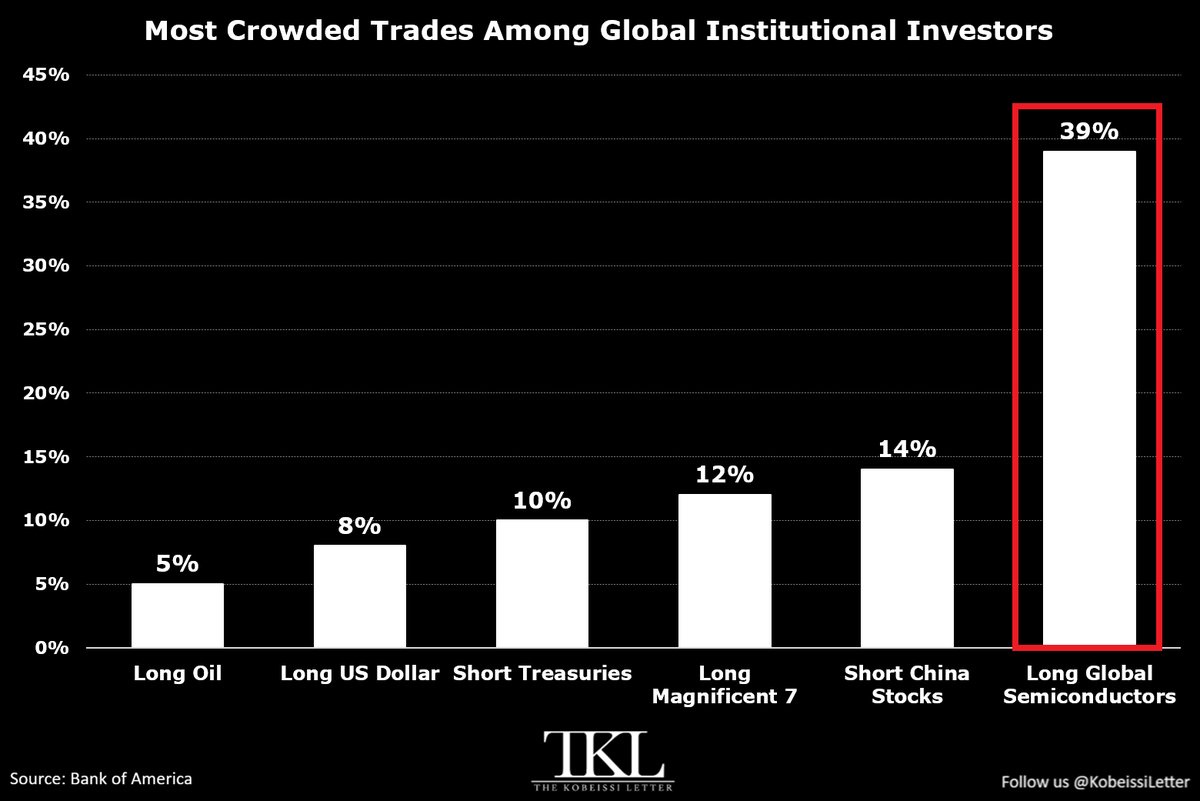
Semiconductors Remain Wall Street's Most Crowded Trade, but Investor Consensus Is Weakening
Global semiconductor stocks remain the most crowded trade among professional investors for a sixth consecutive month, according to Bank of America's November Global Fund Manager Survey, even as enthusiasm for the sector has cooled substantially.
Some 39% of respondents identified long global semiconductors as the most crowded position, down from a record 82% in July. The result suggests that chip stocks remain a widely recognized investment theme, although fewer managers now see positioning as overwhelmingly concentrated.
The survey was conducted between November 6 and November 12, with 193 panelists overseeing approximately $526 billion in assets participating overall. A narrower group of 169 managers responsible for about $461 billion was used for certain survey questions.
Short Chinese equities ranked second among crowded trades, cited by 14% of respondents. Long positions in the Magnificent Seven followed at 12%, while short US Treasuries attracted approximately 10%.
The results come as investors reassess the profitability of artificial intelligence infrastructure spending. Nvidia $NVDA and other semiconductor companies have experienced substantial price volatility, reflecting uncertainty over future growth, capital requirements and the valuations attached to AI-related businesses.
Bank of America's survey also revealed a significant reduction in technology allocations. The share of managers overweight technology fell from a net 37% in October to 12% in November, indicating that investors have been actively reducing exposure despite semiconductors retaining the top crowded-trade ranking.
A crowded-trade reading measures perceptions of investor positioning, not the percentage of assets actually invested in semiconductor stocks. The decline from July's peak therefore points to weaker consensus rather than proving that institutional investors have abandoned the sector.
The findings highlight a market increasingly divided between confidence in long-term AI demand and concern that expectations for future profits have moved ahead of sustainable fundamentals.