US Stocks Suffer Brutal Weekly Selloff as AI Shares Drag S&P 500 Into Correction
US stocks ended November 20 with another sharp decline, extending a broad market correction as concerns over artificial intelligence valuations, elevated interest rates and technology-sector spending weighed on investor confidence.
The S&P 500 $SPY fell 3.7% to 6,910.39, closing below 7,000 for the first time since April and recording its seventh consecutive losing session. The benchmark ended approximately 11.6% below its October record, while the Nasdaq Composite declined 5.3% on Friday and turned negative for the year.
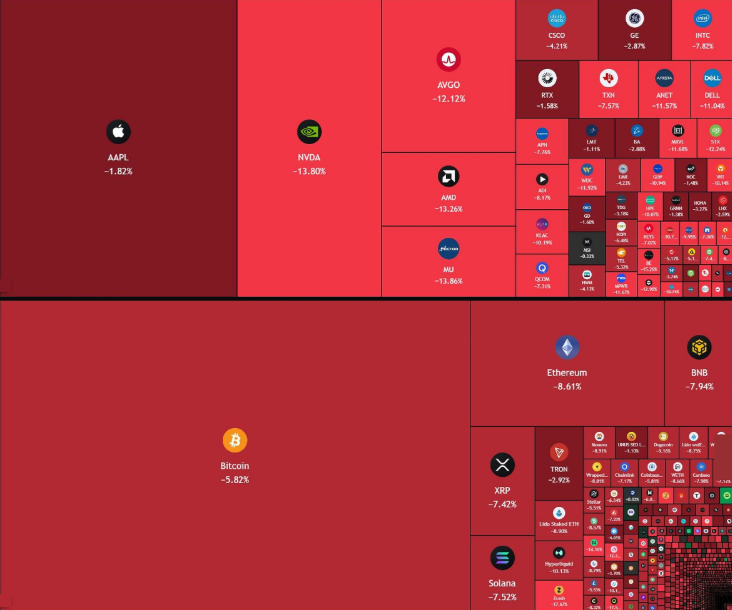
Technology shares led the retreat. Nvidia $NVDA lost approximately 14% in a single session, erasing nearly $500 billion in market capitalization. Broadcom $AVGO, Advanced Micro Devices $AMD, Micron $MU, Amazon $AMZN and other major technology companies also recorded substantial declines as investors reduced exposure to the AI trade.
The semiconductor sector suffered particularly heavy losses, with the PHLX Semiconductor Index falling approximately 10.7% on Friday. According to Dow Jones Market Data cited by MarketWatch, the sector lost roughly $1.3 trillion in market capitalization during the session and approximately $2.3 trillion over the week.
Selling pressure extended globally. Taiwan's benchmark declined 6.2%, South Korea's KOSPI fell 5.2% and Japan's Nikkei lost 5.1%. European equities also weakened, reflecting concern that the reassessment of AI infrastructure valuations could affect international markets and semiconductor supply chains.
Cryptocurrencies were caught in the broader liquidation. Bitcoin $BTC fell toward its lowest level since September 2024, while leveraged positions were closed across digital asset exchanges. The simultaneous weakness in stocks, precious metals and cryptocurrencies suggests investors were reducing overall risk exposure rather than simply rotating between sectors.
Market commentary has estimated losses of several trillion dollars in US equity value during the week and since October's highs. However, figures such as $6 trillion over five days and $8.3 trillion from the peak require consistent index coverage and valuation timestamps. They should not be presented as directly comparable without specifying the methodology.
The correction has renewed questions about how much AI infrastructure spending can ultimately generate in profits. A sustained recovery will depend on corporate earnings expectations, credit conditions, monetary policy and whether buying demand returns across a broader range of companies.