US Approved Nearly 880,000 Nvidia and AMD AI Chips for China Despite National Security Concerns
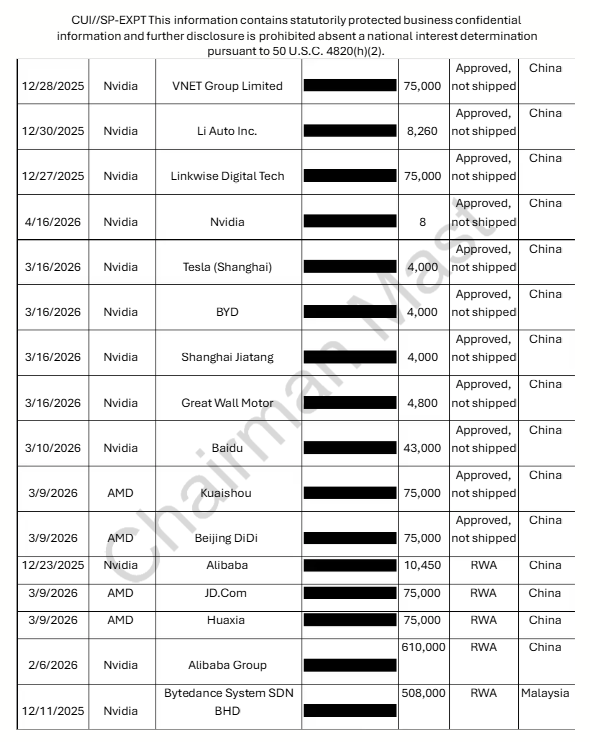
The US Commerce Department approved export licenses covering 879,868 advanced artificial intelligence chips from Nvidia $NVDA and Advanced Micro Devices $AMD to Chinese customers between December 2025 and May 2026, according to records released by the House Foreign Affairs Committee.
The previously confidential licensing information shows that companies applied for authorization to export, re-export or transfer approximately 3.44 million AI processors during the six-month period. The Bureau of Industry and Security approved about one-quarter of that requested volume across 21 applications.
The approvals included approximately 150,000 chips for Tencent, 75,000 for Alibaba, 43,000 for Baidu and 4,000 for electric-vehicle manufacturer BYD. The House committee highlighted that these companies appear on the Pentagon's list of Chinese military-linked businesses, raising questions about how export restrictions were applied.
The licensing decisions followed President Donald Trump's December 2025 move to permit certain Nvidia H200 shipments to approved Chinese buyers under government authorization. That represented a partial change from earlier restrictions intended to limit China's access to advanced American AI computing technology.
The disclosure has renewed debate in Washington over the balance between commercial semiconductor exports and national security. Supporters of tighter controls argue that advanced processors can strengthen military-related computing capabilities, while critics of broad restrictions contend that limiting American sales could encourage Chinese customers to develop alternative technologies.
The House committee also raised concerns about applications involving companies it described as potential intermediaries for prohibited chip transfers. Those allegations remain distinct from confirmed licensing decisions, and a company's inclusion in an export application does not establish that it illegally diverted equipment.
Importantly, authorization to export chips is not equivalent to proof that all approved processors were actually delivered. Nvidia has said the relevant H200 shipments were legal and authorized, while its interim chief executive Colette Kress indicated that the company had subsequently stopped shipments to China, including those previously approved.
The disclosures come amid separate investigations into alleged smuggling of restricted processors through Southeast Asia and scrutiny of semiconductor industry relationships with Chinese technology customers. Those inquiries should not be conflated with the lawful issuance of export licenses.
The controversy could influence future US export policy and the international competitive position of Nvidia, AMD and their customers. Further regulatory decisions will determine whether the government maintains the existing licensing approach or imposes tighter restrictions on advanced AI hardware.