Robin Brooks Challenges Oil Price Predictions, Argues Supply Has Nearly Normalized
Robin Brooks challenges several widely circulated oil market narratives, arguing that recent predictions of $150–$200 oil have been driven more by industry lobbying and fear than by underlying market fundamentals.
He highlights four key arguments:
- **Dated Brent Is Not the Only True Oil Price:** Dated Brent recently traded significantly above front-month futures before falling sharply toward them again. Brooks argues that dismissing the more liquid front-month futures as irrelevant is misleading.
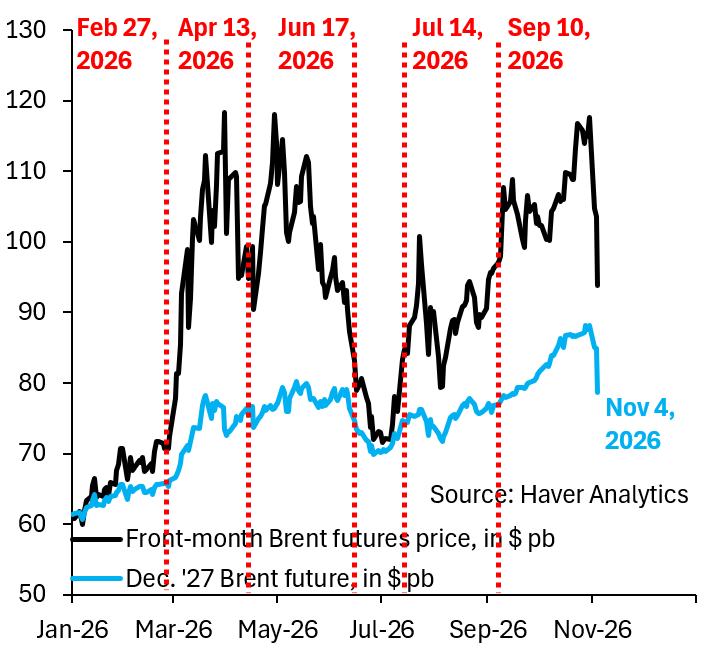
- **December 2027 Futures Offer No Reliable Prediction:** Long-term futures have remained relatively stable while front-month prices have fluctuated significantly. Brooks sees no meaningful predictive signal between the two.
- **Tanker Traffic Has Nearly Recovered:** Data from TankerTrackers.com show Persian Gulf exports are approximately 10% below pre-war levels, while Saudi Arabia's exports are 10% above. This suggests that oil supply has largely normalized despite Iran's exports falling to zero under the U.S. blockade.
- **High Oil Prices Reflect Geopolitical Risk:** Brooks attributes elevated shipping costs to attacks on Saudi Arabia's East-West pipeline and subsequent IRGC attacks. He argues that renewed U.S. military action to secure the Strait of Hormuz could reduce shipping risks and bring oil prices lower.
Brooks maintains that Brent is unlikely to return to $125, his previously identified peak, although he acknowledges that a renewed conflict could push prices higher temporarily. He remains skeptical of extreme $150–$200 oil forecasts and believes the U.S. blockade and sanctions could pressure Iran toward negotiations.