Nasdaq-100 Suffers Rare 10.4% Weekly Decline as AI Selloff Reaches Historic Extremes
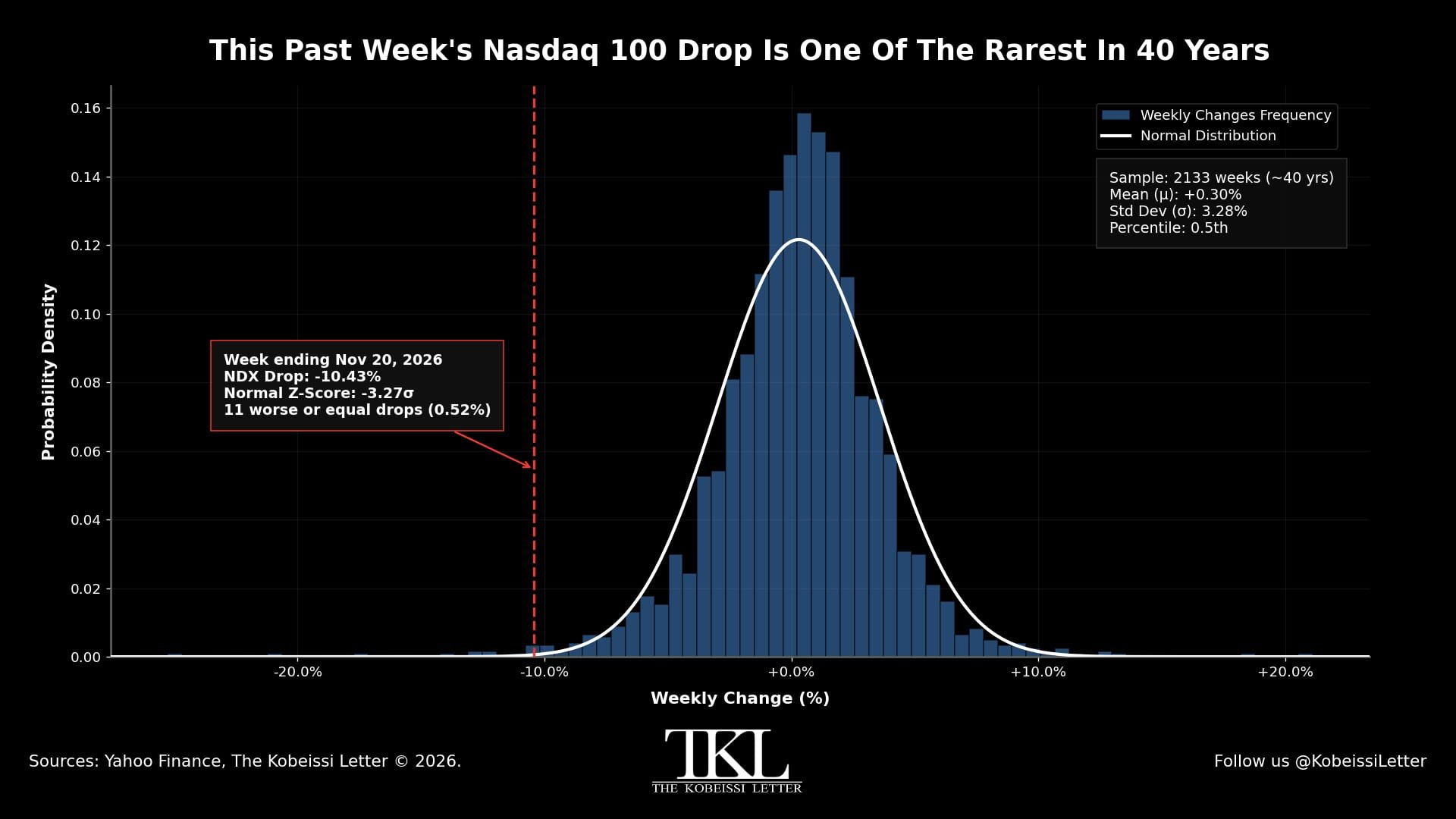
The Nasdaq-100 $QQQ fell 10.4% during the week ending November 20, marking its worst weekly performance since the COVID-19 market turmoil in March 2020 and one of the sharpest declines in the index's history.
The technology-heavy benchmark dropped approximately 5.6% on Friday alone as major AI-related companies extended losses. Nvidia $NVDA and other semiconductor shares were among the hardest hit, reflecting growing investor concern about valuations, infrastructure spending and the financial returns expected from artificial intelligence.
A historical comparison circulated by market analysts estimates that only 11 of the previous 2,133 trading weeks experienced a Nasdaq-100 decline of 10.4% or worse. That would represent approximately 0.52% of the sample, although the precise frequency depends on the historical data series, calculation method and whether the current week is included.
The same analysis describes the weekly move as approximately 3.27 standard deviations below the historical average under a conventional volatility calculation. Such comparisons illustrate the unusual scale of the decline but require an important qualification: financial returns do not consistently follow a normal distribution.
Equity markets exhibit fat tails, meaning very large positive and negative returns occur more frequently than a simple bell-curve model would predict. A move characterized as statistically extreme should therefore not be interpreted as having a fixed probability based solely on the normal distribution.
The decline has pushed the Nasdaq-100 close to a 20% drawdown from its October record, a threshold commonly associated with bear-market conditions. The speed of the correction indicates how quickly investor positioning can change when confidence in a heavily concentrated investment theme deteriorates.
The selloff has also exposed the influence of major technology companies on index performance. When several highly weighted AI and semiconductor stocks decline simultaneously, their combined impact can dominate the benchmark even if weakness develops unevenly across other sectors.
The historical rarity of the weekly drop is notable, but it does not establish that a rebound is imminent or that further losses are inevitable. Market direction will depend on earnings expectations, financial conditions and whether broad buying demand returns after the sharp repricing.