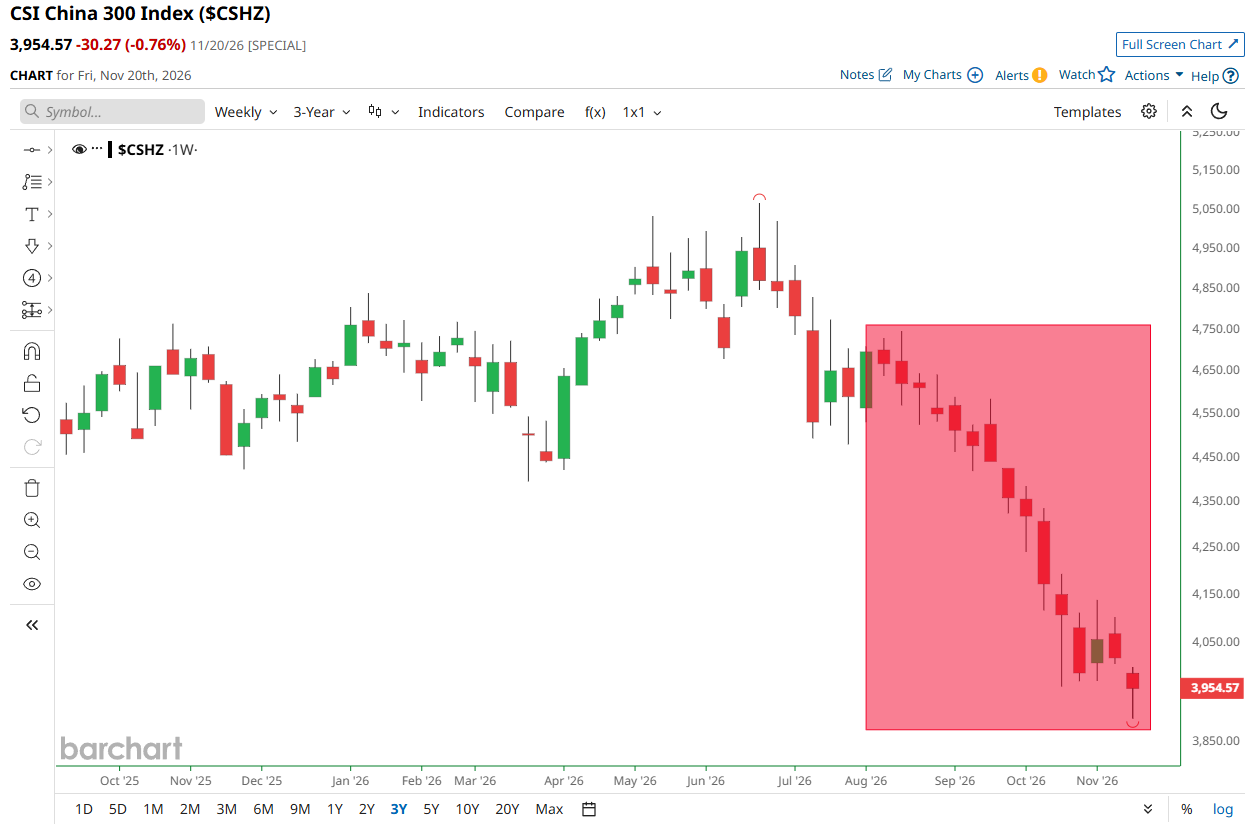
Chinese Equities Extend Prolonged Decline as Shanghai and Shenzhen Indexes Fall Sharply
Chinese equities extended their losses on November 20, deepening a prolonged period of market weakness as investors remained concerned about domestic demand, technology-sector valuations and the outlook for monetary policy.
The Shanghai Composite fell 1.23% to approximately 3,533.79, while the Shenzhen Component dropped 3.09% to 10,256.39. The ChiNext index declined approximately 3.54%, reflecting particularly strong selling pressure among growth-oriented companies.
For the week, the Shanghai Composite lost roughly 2.8% while the Shenzhen Component declined approximately 6.5%. The losses occurred alongside a wider selloff across Asian equity markets, where semiconductor manufacturers and technology companies were among the weakest performers.
Social media commentary has described the Chinese market as recording declines in 14 of the previous 15 weeks, potentially marking an unusually prolonged losing period. However, the exact sequence and the claim that it represents the worst such stretch in history have not been independently established for a specified benchmark.
The broader weakness reflects uncertainty about Chinese consumer spending, property-sector conditions and business profitability. International concerns about AI infrastructure valuations and US semiconductor export restrictions have also affected sentiment toward Chinese technology companies.
The People's Bank of China left its benchmark loan prime rates unchanged in November, maintaining the one-year rate at 3% and the five-year rate at 3.5%. The decision highlighted the challenge of supporting economic growth while maintaining financial stability.
A prolonged equity decline can undermine investor confidence, but its duration alone cannot predict when a recovery will occur. Market direction will depend on corporate earnings, economic data, policy support and whether international selling pressure begins to ease.