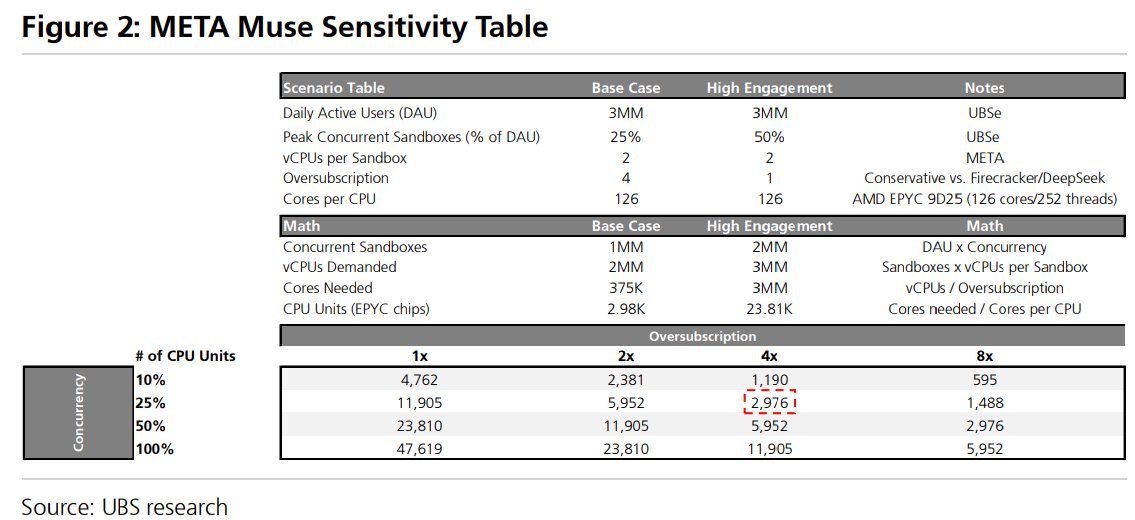
Meta’s Muse AI Could Drive Significant Demand for AMD EPYC CPUs and Memory Chips
UBS estimates that Meta’s ($META) Muse AI platform could generate substantial demand for AMD ($AMD) EPYC server CPUs, even with just 3 million daily users.
The number of processors required depends heavily on simultaneous agent activity and how efficiently CPU capacity can be shared.
UBS outlines two scenarios:
• Base case: Approximately 3,000 EPYC chips, assuming 750,000 agents run simultaneously with 4x CPU sharing.
• High-engagement case: Approximately 23,800 chips, assuming 1.5 million agents run simultaneously without CPU sharing.
The potential opportunity becomes much larger as adoption scales. Under the same base-case assumptions, reaching 100 million daily users could require nearly 100,000 EPYC chips.
Memory and storage demand could also increase significantly. Each Muse agent is estimated to require 8GB of RAM and 100GB of SSD storage. With 4x CPU sharing, DRAM requirements could reach approximately 2TB per host.
This could create additional opportunities for Micron ($MU) and SK hynix ($SKHY) in DRAM, as well as SanDisk ($SNDK) in NAND flash storage.
The broader takeaway is that the expansion of AI agents could drive demand beyond GPUs, extending into server CPUs, memory and storage infrastructure.