Markets Face Volatile Monday Open After Global AI Selloff and Fresh Middle East Tensions
Global investors are preparing for a potentially volatile opening on Monday, November 23, following one of the sharpest technology-led market corrections in years and renewed geopolitical tensions in the Middle East.
The Nasdaq-100 $QQQ fell approximately 10.4% during the week ending November 20, its steepest weekly decline since March 2020. The S&P 500 $SPY recorded seven consecutive declining sessions, while semiconductor stocks suffered particularly severe losses.
The pressure extended across international markets. Taiwan, South Korea and Japan experienced sharp equity declines as investors reduced exposure to semiconductor manufacturers and other companies closely linked to AI infrastructure spending.
Bitcoin $BTC also experienced substantial volatility, briefly falling toward $55,000 before recovering above $60,000 during Saturday trading. The rebound demonstrates that buying interest remains present, although cryptocurrency markets continue to face weak institutional flows and elevated derivatives volatility.
Weekend reports of Iranian attacks involving US facilities in Bahrain and incidents affecting tankers near the Strait of Hormuz have introduced another potential source of market uncertainty. The strategic importance of the waterway makes any disruption relevant to energy prices and global shipping.
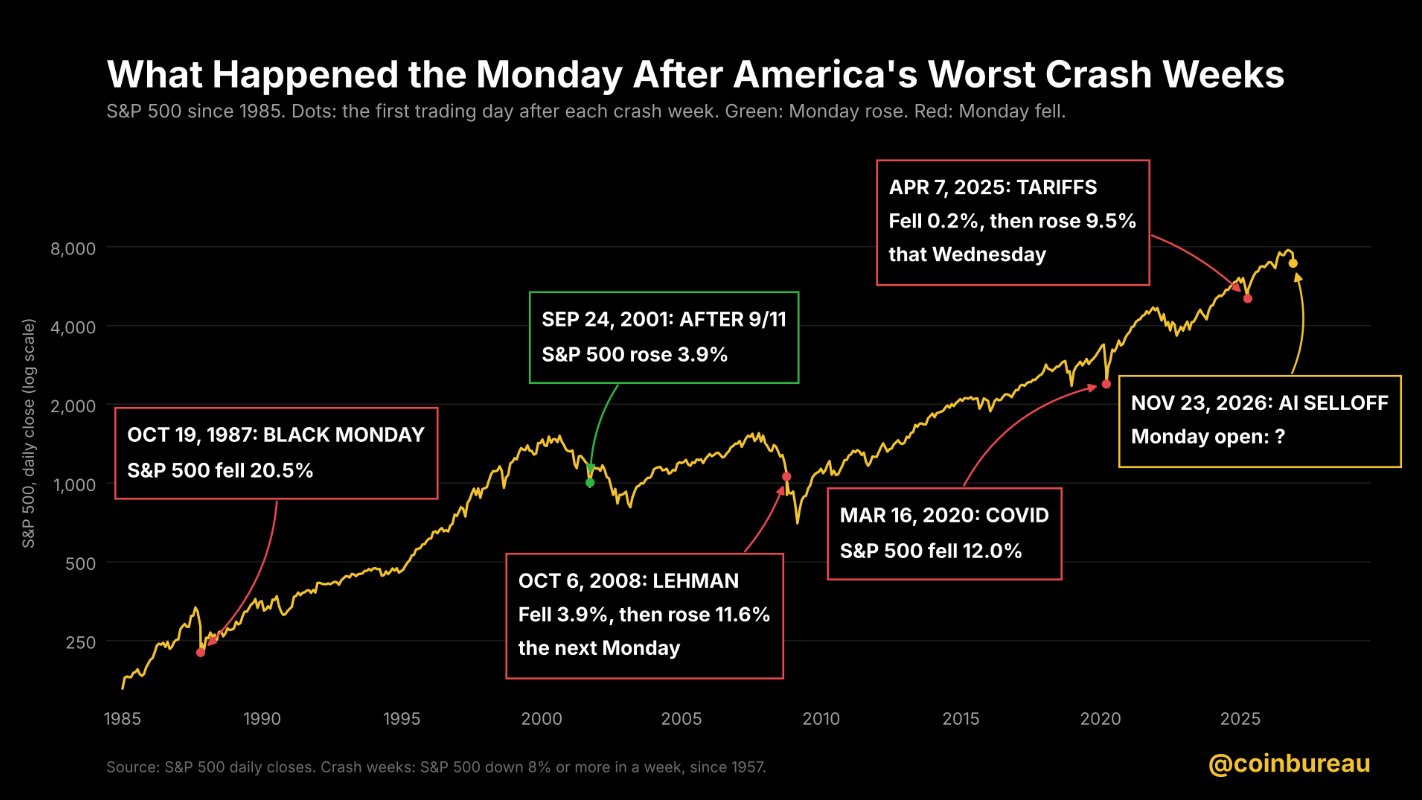
Historical comparisons show that extreme weekly stock market losses have sometimes been followed by sharp rebounds and sometimes by further declines. A cited sample of 12 similarly severe S&P 500 weeks produced six positive and six negative following Mondays, although the result depends on how the historical episodes were selected.
The comparison is too limited to establish a dependable trading signal. The economic circumstances surrounding the 1987 crash, the 2008 financial crisis, the 2020 pandemic and the current AI correction differ substantially.
Investors will be watching US equity futures, Treasury yields, oil prices and developments in the Middle East for signs of how the market is adjusting to the latest risks.
A sharp rebound is possible after extensive selling, but it is not guaranteed. The opening session will help reveal whether investors are willing to add risk again or whether systematic selling and geopolitical uncertainty continue to dominate.