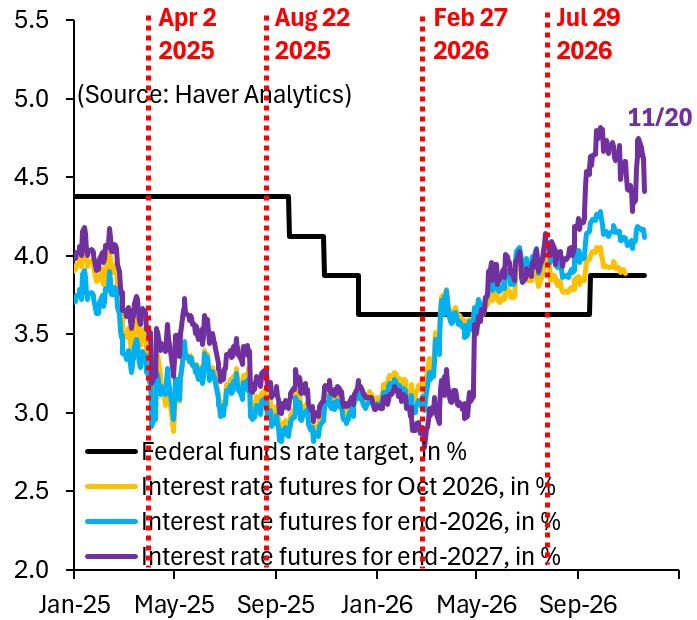
Robin Brooks Warns Fed Policy Discord Under Chair Kevin Warsh Risks Triggering a Market "Accident"
Economist Robin J. Brooks warned on November 20, 2026, that internal policy disagreements at the Federal Reserve—previously characterized by Fed Chair Kevin Warsh as a "good family fight"—have become a destabilizing cacophony that is driving up real interest rates and raising the risk of a financial market "accident."
Brooks argued that contradictory messaging across the Federal Open Market Committee (FOMC) has eroded policy clarity:
- Forward Guidance Contradictions: Although Warsh has opposed forward guidance, FOMC officials have delivered a stream of conflicting public speeches outlining divergent rate paths.
- Data-Dependence Inconsistency: Despite Warsh's pushback against tying policy to single data releases, Fed Governor Christopher Waller explicitly linked a potential 50-basis-point rate hike in December to the October core Consumer Price Index (CPI) print.
- Unaddressed Supply-Shock Dynamics: Brooks noted that Warsh has failed to steer the committee's debate around how 2026 oil price spikes—triggered by the conflict with Iran that began in late February 2026—have elevated headline inflation figures.
Comparing current cross-asset stress against the 2022 Russia-Ukraine war and rate-hiking cycle (indexed to pre-war baselines of February 23, 2022, and February 27, 2026), Brooks flagged deteriorating signals across both spot and options markets:
- Spot Market Liquidation: Sharp moves in the S&P 500 ($SPX) and rapid U.S. dollar appreciation against emerging market currencies point to forced position liquidations driven by elevated real interest rates.
- Options Market Volatility: Thirty-day implied volatility across equities ($VIX), crude oil, bonds, and high-yield corporate credit has surged—with the $VIX returning to levels last seen in the opening days of the Iran conflict—leaving markets vulnerable to severe dislocation if hostilities escalate again alongside tight monetary policy.
Brooks concluded that Warsh must transition from acting as a passive convener to actively projecting his own policy view to restore FOMC alignment and calm market volatility.